
Baltimore council presses BGE, OPC over surging bills and pipeline replacements
Get AI-powered insights, summaries, and transcripts
Sign Up Free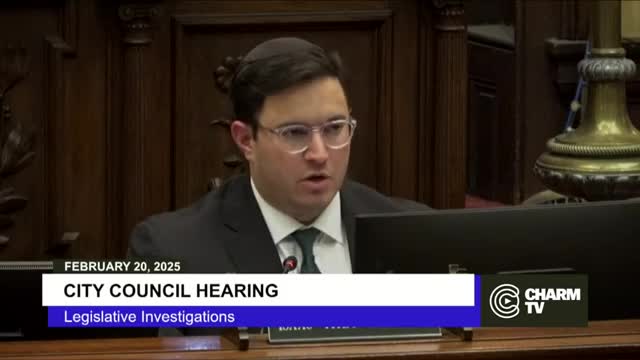
Summary
At a Baltimore City Council hearing, members questioned Baltimore Gas and Electric and the Maryland Office of People’s Counsel about rising winter bills, multi‑year rate plans and the pace and scope of pipeline replacement work. Testimony documented households choosing between heat, medicine or food and renewed council calls for state action.
Baltimore City Council members pressed Baltimore Gas and Electric (BGE) and the Maryland Office of People’s Counsel (OPC) at a Legislative Investigations Committee hearing over sharply higher winter utility bills and the company’s multi‑year pipeline replacement program.
Councilman Isaac Schleifer, chair of the Legislative Investigations Committee, opened the session by saying the committee sought “a full understanding of how we got here and what can be done to prevent this situation from escalating.” He called BGE’s current rate trajectory “simply not sustainable for our constituents.”
The hearing combined company testimony about weather and market drivers with pointed critiques from OPC and dozens of residents who said bills had become unaffordable. David Lapp, Maryland people’s counsel, told the committee that multi‑year rate plans and related cost‑recovery mechanisms have shifted risk to customers and “have contributed to the massive rate increases that have occurred.” Lapp said the OPC’s office had petitioned the Public Service Commission (PSC) for rules to limit punitive late fees and deposits and urged the PSC to end multi‑year rate plans.
BGE executives framed the price spike as a mix of factors. Charles Washington, BGE vice president of governmental and external affairs, and Mark Case, the company’s vice president of regulatory policy and strategy, said unusually cold weather raised customer usage and that recent rises in wholesale supply prices increased bills. Washington said supply price movements were “completely outside of BGE’s control.” Case added that distribution (the portion of bills that pays for the local system) accounted for roughly 8% of the increase between the periods BGE emphasized in testimony, while higher usage and supply price movements explained other portions.
Company witnesses also defended the pace of pipeline replacement as a safety priority. Dawn White, BGE vice president of gas, said BGE serves 7,600 miles of gas distribution mains and had replaced nearly 500 miles since a systemwide program began in 2014, leaving roughly 900 miles of older cast‑iron pipe. White said PHMSA (the Pipeline and Hazardous Materials Safety Administration) has identified cast iron as an outmoded material and urged replacement; she said BGE’s work has reduced leaks and that recent storms required major restorations for thousands of customers.
Lapp and several council members disputed the scope and pace of replacements and the regulatory incentives that allow costs to be recovered through customer bills. The committee displayed slides from Exelon investor presentations and public filings that council members said linked the multi‑year plans to shareholder earnings. Council President Cone recalled the council’s 2023 resolution urging the PSC to reject a multi‑year plan and repeated a call for the PSC to cancel BGE’s planned 2026 increase.
Where residents spoke, testimony focused on immediate hardship. Multiple speakers described bills that jumped into the hundreds or thousands of dollars in a single month, missed medication and choosing between food and heat. One speaker said a January bill rose from about $390 to $975 in two months; others described budget‑billing arrangements that still left them with large arrears. Several residents and community representatives also criticized construction impacts—broken sidewalks, sinkholes and uneven repaving—attributed to pipeline work and to contractors working for BGE.
BGE described near‑term customer‑support steps: waiving late fees and suspending disconnections through March, fielding community meetings and maintaining customer‑care teams to enroll eligible customers in assistance, payment plans and budget billing. The company said it had run or scheduled more than 70 community meetings through April and supported outreach programs to connect residents to state and federal assistance and to a fuel fund and other grants.
Council members pressed for additional actions: clearer, district‑specific project lists and timelines; better communications about regulator installations and customer options after a PSC order; and stronger city and state oversight of cost recovery mechanisms that transfer large capital expenditures into customer bills. Council President Cone said the council would continue hearings and “be back before the Public Service Commission to make sure our ratepayers and our residents get the justice they deserve.”
The hearing did not produce a formal vote or binding local policy changes. Instead, it reiterated the council’s intent to press the PSC and state lawmakers on changes including repeal or reform of the accelerated cost‑recovery law for pipelines and closer limits on multi‑year rate plans. OPC asked the PSC to end such plans and to require tighter oversight of project justifications; BGE said it opposed legislation that would pause safety work while the company and federal regulators consider replacements.
The hearing made clear the split in goals: council members and OPC stressed affordability and limiting cost‑recovery that raises bills now, while BGE emphasized system safety, compliance with federal pipeline guidance and the need to preserve investor access to capital for large projects. Residents’ testimony underscored immediate economic distress as council members said they would continue oversight and explore legislative and regulatory options.
Ending: The Legislative Investigations Committee adjourned after several hours with a public pledge from council leaders to continue scrutiny of BGE’s rates and capital plans and to press the PSC and state legislature for changes to protect Baltimore ratepayers. The committee said it will hold additional hearings and follow up on enforcement of PSC notices, contractor work quality and the availability of customer assistance.