
Board denies encroachment request for 16x16 addition in Bay Highlands
Get AI-powered insights, summaries, and transcripts
Subscribe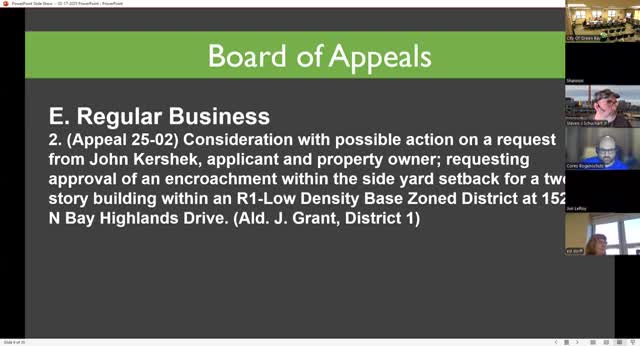
Summary
The Green Bay Zoning and Planning Board of Appeals denied a request to site a 16-by-16-foot three-season room within the required side-yard setback in the Bay Highlands neighborhood, finding alternatives exist and the applicant did not meet variance standards.
The Zoning and Planning Board of Appeals voted Feb. 17 to deny an applicant's request to place a 16-by-16-foot addition within the eight-foot side-yard setback for a two-story primary building in the Bay Highlands area.
Staff told the board the property is in an R-1 low-density base zone and that the code requires an eight-foot side-yard setback for a two-story primary building; the proposed addition would sit approximately two feet from the property line. The lot is part of a planned development originally recorded in the 1970s; although the development has private covenants and an HOA, the board's jurisdiction is the city's underlying R-1 zoning.
Applicant John (last name recorded in the agenda as Bershac) said he purchased the property in January 2023 and seeks the three-season room to create privacy and usable backyard living area. He provided an approval letter from the Bay Highlands Property Owners Association architectural committee and said the architect and contractor recommended the proposed placement for roofline/flow considerations.
Neighbors and HOA representatives (Amy Robinson and an email from David Blackman, HOA president) said the condo association and architectural committee approve the design; Robinson told the board the area comprises oddly shaped lots and the addition would mainly be garage-to-garage adjacency rather than living-space proximity.
In deliberations several board members said they sympathized with the applicant's desire for privacy and that the site is unusually sited on the lot, but that the variance test requires findings on intent, exceptional circumstances, hardship and non-detriment. Some members noted practical alternatives: siting the addition elsewhere on the lot to meet the eight-foot setback or reducing the depth (for example to about 12 by 16 feet) so the addition could meet permitted setbacks for a single-story addition. Several members also raised concerns about setting a precedent that would encourage construction that bypasses code requirements.
A board member moved to deny the request for lack of exceptional circumstances and necessity; the motion was seconded and carried on a voice vote. The applicant was told the board's action was final at the meeting and staff advised about options for redesign and reapplication.
The board then moved on to other agenda items.