
Green Bay Zoning Board denies variance request for driveway at 3633 Arcadia Lough Drive
Get AI-powered insights, summaries, and transcripts
Subscribe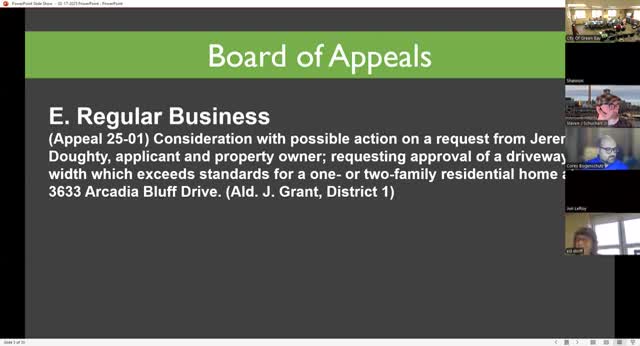
Summary
The Green Bay Zoning and Planning Board of Appeals denied a variance request from the owner of 3633 Arcadia Lough Drive to formalize an expanded front-yard driveway installed after the home's original construction, concluding the application did not meet the board's standards for exceptional circumstances.
The Zoning and Planning Board of Appeals of Green Bay on Feb. 17 denied a variance request from the owner of 3633 Arcadia Lough Drive to keep an expanded front-yard driveway that exceeds city driveway standards.
The board said the applicant did not demonstrate the exceptional circumstances necessary to grant a variance from chapter 40 (driveway standards cited in the staff packet). The board's motion to deny passed on a voice vote.
City planning staff told the board the property was built in 2021 with an approved site plan showing a typical driveway to the three-stall garage. A widened area was installed after construction and appears in a Google Street View image captured in October 2022. A complaint about the unpermitted work was filed Dec. 13, 2023, and the property sold in October 2023, staff said.
Applicant Jeremy (surname reported in the agenda as Doty; he identified himself as Dody at the hearing), who said he purchased the house Dec. 24, 2023, told the board the driveway expansion and a polymer deck were done by the previous owner and that he inherited the works when he bought the home. He said he has paid inspection/processing fees and a contractor to modify the deck and installed a sidewalk at his own expense. He told the board removal of the poured concrete would be a further financial hardship.
Supporters who spoke said the widened apron created no traffic or safety problems, that the feature is minimally intrusive to neighbors, and that removing it would leave unsightly scars and be costly for the new owner. Staff and multiple board members emphasized the code requirement that driveway parking area must lead directly to a garage door opening with the specified width and depth and noted the expansion functions as driveway space contrary to the code citation included in the staff report.
In deliberations several members said they sympathized with the applicant's financial situation but concluded the variance standards require more than an economic hardship and typically focus on physical or property-specific constraints. Board members referenced concern about opening a path to developers or sellers evading permits by selling properties after unpermitted work, and several members noted past cases in which owners were required to remove unpermitted concrete.
After hearing public comment and discussion, a board member moved to deny the variance (finding failure at least on the exceptional-circumstances criterion); the motion was seconded and carried on a voice vote. The board advised the applicant that civil remedies between buyer and seller are a private matter and that circuit court review is an available appeal route for landowners dissatisfied with board rulings.
The board moved to the next agenda item following the vote.