
Zoning board approves kennel variance for 2888 Sullivan Road
Get AI-powered insights, summaries, and transcripts
Subscribe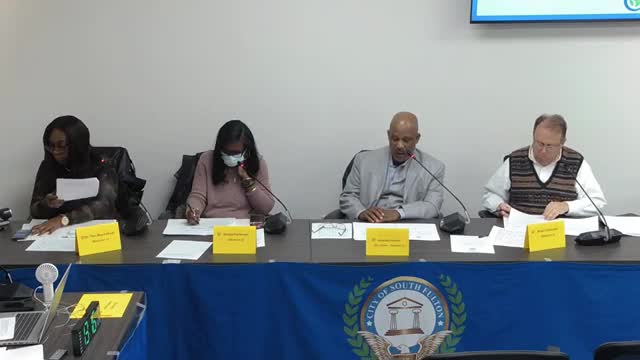
Summary
The Zoning Board of Appeals for the City of South Fulton on Feb. 20 approved a variance allowing kennel operations at 2888 Sullivan Road that will permit outdoor runs and other activities not confined to a completely enclosed, sound‑proof structure.
The Zoning Board of Appeals for the City of South Fulton on Feb. 20 approved a variance allowing kennel operations at 2888 Sullivan Road that will permit outdoor runs and other activities not confined to a completely enclosed, sound‑proof structure.
The decision clears a request to vary section 302‑2 of the zoning code to allow the boarding and care of animals with outdoor access rather than requiring all activity inside fully enclosed, sound‑proof space. Chair (unnamed) moved approval; the motion was seconded and carried with no recorded opposition.
Applicant Lindsey Maroon, who said she owns Feathers and Fur Express and currently handles international pet transport, told the board the site is a roughly 2‑acre parcel surrounded largely by industrial uses and major roadways. “We expect maybe 30 to 45 dogs rotating at a time and 10 to 15 cats,” Maroon said, describing day‑to‑day operations and the temporary nature of outdoor runs.
Maroon said the building on the site is a 3,000‑square‑foot structure from the 1930s and that outdoor runs are difficult or impossible to fully sound‑proof. “It’s impossible to soundproof outdoor runs,” she said, arguing that full soundproofing would be impractical and costly for the business model. She also said the business will provide 24‑hour on‑site management using an apartment in the converted attic of the building.
Board members questioned fencing, overnight management and breed restrictions. A board member asked about fence height and multiple barriers between the kennels and adjacent busy roadways; Maroon said the property is already surrounded by security fencing on the sides and rear and that internal kennel fences would be roughly 6 to 8 feet. On management and noise control, she said staff would monitor animals and bring persistently barking dogs indoors quickly.
Maroon described nearby distances and noise expectations, saying the closest residence is about 575 feet away and that a standard 90‑decibel dog bark will fall to roughly 38 decibels at 400 feet under a basic attenuation calculation that she submitted to the board. She noted barriers including two lines of trees and nearby railroad tracks between the site and some surrounding properties.
Board members asked whether the facility would impose breed restrictions; Maroon said the business would not enforce breed bans because the international transport business frequently receives animals whose breed reporting is inconsistent and aggressive animals are typically avoided by the industry.
After discussion the board voted to grant the variance. Chair (unnamed) closed the hearing by saying, “So your variance is granted, miss Moore Road, and I wish you all the best.”
The applicant and board did not state a specific numerical vote tally during the public record; the meeting minutes will record the official vote count.
The project now proceeds under the terms of the granted variance; the board did not attach conditions that were stated on the record during the hearing.