
CalHFA auditors report clean opinions on FY 2023–24; committee urged to review loan-loss allowance and SB 2 funding decline
Get AI-powered insights, summaries, and transcripts
Subscribe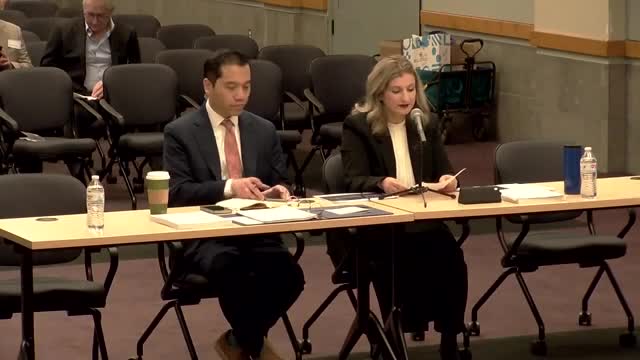
Summary
At a meeting of the California Housing Finance Agency Audit and Risk Management Committee, external auditors reported unmodified ("clean") opinions on CalHFA's fiscal-year 2023'24 financial statements and on federal awards and said they identified no findings or material weaknesses.
At a meeting of the California Housing Finance Agency Audit and Risk Management Committee, external auditors reported unmodified ("clean") opinions on CalHFA's fiscal-year 2023'24 financial statements and on federal awards and said they identified no findings or material weaknesses.
The audit was presented by Mandy Merchant and Elizabeth (Liz) Richardson of CliftonLarsonAllen and introduced by Oksana Gluchenko, CalHFA comptroller. Gluchenko told the committee the auditors "formally sign[ed] off on this year audit on December 9," and she noted the agency received the certificate of excellence in financial reporting from the Government Finance Officers Association for the seventh consecutive year.
The clean opinions and lack of reportable deficiencies give CalHFA a favorable external assessment of its financial reporting and internal controls. Committee members focused discussion on two operational risks highlighted in the audit material: the allowance for program loan losses and the decline in SB 2 revenues that help fund the agency's Mixed Income Program.
Merchant described the audit scope and results, saying the firm issued "unmodified opinions" and that "we had no findings" on internal control over financial reporting or compliance with federal awards. She explained the firm used a risk-based approach that included testing loans and confirmations for single-family and multifamily portfolios.
Audit and financial highlights reported to the committee (figures as presented by the auditors):
- Cash and investments: an $82.9 million increase, driven primarily by a new Affordable Housing Revenue Bond issuance and higher money market balances.
- Noncurrent investments: a $101.5 million increase, primarily from purchases of mortgage-backed securities.
- Program loans receivable: a net increase of $56.8 million, mainly due to multifamily lending tied to the new bond indenture; auditors noted a net increase in about 10 multifamily loans that have larger dollar values.
- Loans payable and bonds payable: increases of $53.2 million and $79.9 million, respectively, reflecting new borrowings and the AHRB issuance.
- Revenue and expenses: a $36.5 million increase in net interest income driven by more favorable market rates; a $17.8 million decrease in loan fees associated with about a 4% drop in single-family loan volume (roughly 1,500 fewer loans); and a $27.9 million increase in salaries and general expenses primarily tied to pension and OPEB estimate changes.
On the allowance for loan losses, the committee heard staff and auditors describe the agency's methodology. Oksana Gluschenko said the allowance process is "based on the formula of historical performance" and that CalHFA is "closely monitoring portfolios"; she added that for portions of the portfolio CalHFA "maintain[s] the regular percentage, maybe 10%." Auditor Mandy Merchant advised the committee to review Note 5 of the financial statements, observing: "You have a $86,000,000 allowance right now. Is that sufficient for our portfolio?"
Merchant and Richardson described the audit's testing approach: sampling cash disbursements and payroll, sending a few hundred monetary-unit confirmations to borrowers and multifamily projects, and using historical write-off experience plus single-identification of past-due loans to evaluate allowance adequacy. Both auditors said they found no large write-offs or real-estate-owned (REO) events in the audited year.
The committee also discussed accounting standard changes that may affect future audits: new AICPA-related auditing standards increasing IT-focused procedures and the upcoming GASB guidance on compensated absences (GASB 101). Merchant summarized GASB 101 as requiring agencies to review policies and "estimate probability" of paid leaves (vacation, sick, parental, military) and to recognize related liabilities more consistently. Committee members asked staff to quantify CalHFA's exposure under the new guidance and to report back with historical comparisons.
Committee direction and next steps: Chair Sotelo and other members requested that staff bring comparative, multi-year data to the committee to link program activity and risk (for example, historical allowance usage and the recent decline in SB 2 allocations). Gluchenko and staff said they would include that analysis in future meetings; the committee scheduled a May 20 meeting to review the agency's risk framework and suggested using the audit as a tool for that assessment.
No public comments were raised during the audit presentation.
Ending: Committee members praised the audit team's work and stressed follow-up analysis. The committee moved on to an update on the audit services contract process following the discussion.