Get Full Government Meeting Transcripts, Videos, & Alerts Forever!
Get email alerts on the Education Funding topic
No spam. Unsubscribe anytime.
Racine Unified asks voters April 1 to approve $190 million over five years to balance budget
Summary
Racine Unified School District will ask voters on April 1 to approve $190 million in referendum authority over five years to cover projected operating shortfalls and preserve staff, programs and class sizes; the district says the ask is intended to maintain the current, reduced budget rather than add new programs.
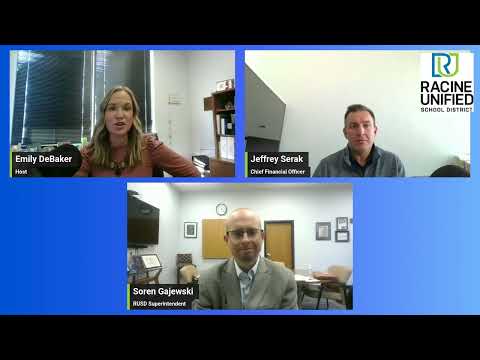
Superintendent Soren Gajewski said Racine Unified School District will ask voters on April 1 to approve $190,000,000 in referendum authority spread over five years to balance the district’s operating budget.
“Our ask, is over the next 5 years, We're asking for a total of $190,000,000 and this is specifically to balance the current budget over the next 5 years. The vote is on April 1,” Superintendent Soren Gajewski said.
The district says the request reflects projected deficits in each fiscal year and is intended to sustain the district’s current, reduced level of services rather than fund new facilities or large new programs. Chief Financial Officer Jeff Sirick described how the $190 million request maps to projected shortfalls by fiscal year: about $26 million in FY 2026, $30 million in FY 2027, $38 million in FY 2028, $46 million in FY 2029 and $50 million in FY 2030.
Gajewski and Sirick told the district’s podcast that the gap has widened in part because state revenue increases have not kept pace with inflation since legislation passed around 2009, and because some state mandates, including components of “Act 20” related to literacy programming, were not fully funded. The district said it eliminated roughly $34 million from its budget last year through staffing and program cuts and cannot continue that level of reductions without further affecting classroom services.
If approved, district leaders said the funds would be used to maintain classroom staffing levels and supports that officials say affect daily learning: educational assistants, counselors and social workers, school safety staff, and classroom teachers that influence class size. Officials also said the funds would help keep the district’s career academies and school-choice programs — such as arts, international baccalaureate, and engineering tracks — operating at current levels.
The referendum is not a reallocation of the district’s 2020 facilities referendum. Gajewski said the 2020 measure was written specifically for facilities work and those funds are being spent on construction and renovation projects and cannot be diverted to operating costs.
On taxes, Sirick said the modeled property-tax impact would be about $0.35 per $1,000 of assessed value, holding steady each year of the five-year period. Under that model, a $200,000 home would pay about $70 annually. The district published a property-tax calculator at rusd.org/referendum and offered an email address for inquiries: referendum@rusd.org.
District officials urged residents to consider the broader community effects of school funding and to contact state legislators about long-term changes to school finance. They said frequent referendums across Wisconsin reflect a structural issue they believe the state legislature and governor should address to avoid widening disparities between districts.
Background and context: district leaders attributed the need for the referendum to long-term differences between inflation and state revenue growth going back to about 2009, the effect of unfunded state mandates including Act 20 literacy requirements, and a $34 million shortfall addressed last year by cuts. The district said the referendum amount reflects the operating budget at its current, reduced level and is intended to preserve services currently in place.
Outcome and next steps: the referendum question will appear on the April 1 ballot. If it does not pass, the district said it expects further staff reductions and program cuts that would affect class sizes, student supports and extracurricular offerings.