Get email alerts on the Rv Parks Ldr topic
No spam. Unsubscribe anytime.
Commissioners set workshop after hearing substantial changes proposed for campgrounds and RV parks
Summary
County staff proposed major changes to land development regulations for campgrounds and RV parks — larger minimum campsite sizes for vehicular accommodations, 20‑acre minimums, 50‑foot natural buffers, centralized water and sewer — and the board tabled action to allow a workshop March 6 and a public hearing March 20.
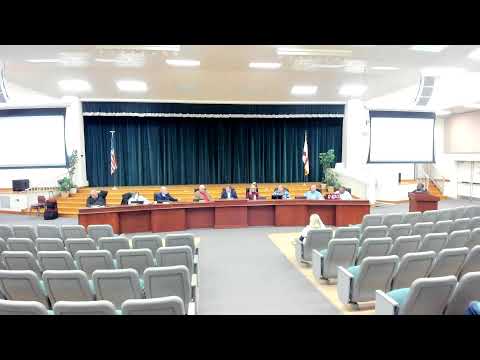
Columbia County commissioners held a public hearing on a proposed ordinance to amend the county’s land development regulations (LDRs) governing campgrounds and RV parks. County staff said the draft ordinance would replace the former single standard approach and introduce a list of new, more restrictive standards intended to limit density and require infrastructure investment.
Key proposed changes described by county staff included:
- Any campsite that will accommodate an RV, trailer, portable tiny home or other vehicular accommodation would have to be 4,500 square feet (roughly 45 by 100 feet) rather than the county’s prior, smaller campsite standard. - Parcels used for campgrounds or RV parks would have to be at least 20 contiguous and reasonably compact acres; smaller scattered parcels would not qualify. - A 50‑foot natural buffer would be required along project boundaries (with an administrative variance process available for special circumstances). - Campgrounds could not adjoin platted subdivisions with lots of 5 acres or less (recorded subdivisions only), a new restriction intended to reduce conflicts with small‑lot residential neighborhoods. - Centralized water and wastewater would be required: either connection to a public utility, a centralized treatment/packaged plant, or a centralized well with treatment; septic tanks for individual sites would not be allowed under the proposed standard.
County staff told the board these changes were intended to shift higher‑density vehicular accommodations toward locations with existing infrastructure (for example, interstate interchanges) and to increase setbacks and buffers near residential areas.
Commissioners and public speakers said the changes would be transformative for the county. One public commenter, Edward Ottinger, described his planned 55‑and‑older park design (30 sites on 8 acres) and asked how the new rules would affect projects already in process; staff agreed to include such projects in the upcoming workshop discussion. Staff cautioned that the proposed standards would make many proposed or existing small RV parks economically infeasible and could reduce the number of new parks in the county.
After discussion, the board voted to table the ordinance and to schedule a workshop on March 6 (morning) with a continued public hearing set for the board’s evening meeting on March 20. Staff recommended cross‑noticing the workshop with the regular meeting and advised a date‑certain tabling so the public hearing could be reopened in March without repeating the advertisement.
By tabling the item and scheduling a workshop, commissioners created a structured opportunity for staff, developers, and residents to review the proposed standards and for commissioners to consider amendments before final adoption.
AI generated
The text on this page is AI generated. Summaries, highlights, analysis, and video transcripts are all produced from the original source material.
AI can make mistakes, so if you spot one, and we will fix it for everyone.
Note: the source content is unaltered by us. Any content source we link to, be it a video, an audio recording, or a document, is presented exactly as its publisher released it. That publisher is usually a government body, sometimes an individual official or another organisation.