Get Full Government Meeting Transcripts, Videos, & Alerts Forever!
Get email alerts on the Housing topic
No spam. Unsubscribe anytime.
Wilsonville council reviews 6-year housing production strategy; consultants recommend targeted, achievable actions
Summary
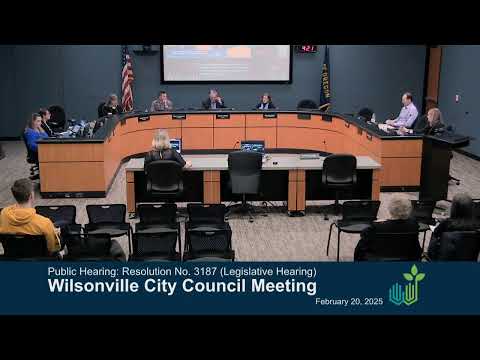
City staff and consultants presented a recommended six‑year Housing Production Strategy at the Feb. 20 work session that prioritizes targeted rezoning, incentives for diverse housing types, accessibility measures, preservation of income‑restricted housing and consideration of a housing specialist and construction excise tax.
City staff and consultants presented a recommended six-year Housing Production Strategy (HPS) at the Feb. 20 Wilsonville City Council work session, proposing a focused set of actions the city can pursue to increase housing choice and preserve affordability while meeting state HPS requirements.
Kimberly Reibold, the city’s senior planner, introduced the item and said the HPS will be the city’s six-year action document to address identified housing needs. Consultants Beth Goodman and Nicole Underwood of Agua Northwest walked the council through the recommended and non-recommended actions and the statutory context for the HPS.
Why it matters: Under recent state rules and the Home Builders/land-use framework the HPS must include actions that are achievable within six years and document how the city will address identified housing needs — including affordable homeownership, affordable rental housing, housing stability, housing choice, geographic placement of future housing and support for people exiting homelessness.
Key findings and recommended actions
- Project scope and timing: The HPS follows a housing needs and capacity analysis that concluded Wilsonville has sufficient buildable land to accommodate growth; the HPS focuses instead on affordability challenges, preserving existing affordable stock and expanding housing choice. The city must submit an adoption-ready HPS by June 2025; staff said the council will see a draft in an April work session.
- Recommended planning and regulatory actions: identify targeted land for rezoning to allow a wider range of housing types; consider mixed-housing requirements in specified areas; evaluate incentives for factory-built, modular or manufactured housing; continue to allow a mix of housing types across zones and explore clearer objective standards and administrative review pathways to speed housing delivery.
- Accessibility and preservation: adopt incentives or requirements to increase units that comply with universal design or lifelong housing standards; monitor at-risk income-restricted properties and work with owners and the state to preserve affordability when tax-credit periods expire.
- Staffing and funding tools: the consultants recommended creating a housing specialist position (position description and funding analysis) to manage implementation and to evaluate a construction excise tax (CET) as a local revenue source to support housing programs, administration and incentives.
- Actions deferred for future consideration: several affordable-homeownership programs, a community land trust, and more resource-intensive programs were identified as desirable but not recommended for immediate inclusion in the six-year HPS because they are resource- and time-intensive and depend on new funding sources.
State context and council concerns
Consultants framed the HPS as bounded by state rules and the need to show “good faith” toward feasible actions. Council members raised concerns about statewide expectations and funding. Councilor Dunwell said the state’s requirements and limited state funding constrain Wilsonville’s ability to choose local priorities and worried that implementing required actions without state support could divert resources from other city priorities. Consultants noted that the HPS can and should document aspirational future actions as well as those recommended for the six-year horizon, and that the state permits substitution of actions at a midpoint review if a city cannot complete an item.
Data and equity focus
Consultants summarized cost-burden and income distribution data from the American Community Survey, noting significant renter cost burden: more than 50% of renter households in Wilsonville are cost-burdened and nearly 30% are severely cost-burdened (as calculated by ACS definitions). Councilors probed how rent and utility data are collected; consultants said the data come from the U.S. Census Bureau’s ACS and are self-reported, which can undercount certain out-of-pocket mandatory costs but allow consistent comparisons across jurisdictions.
Next steps and accountability
Staff and the task force will finalize a recommended list of HPS actions; the tourism promotion committee example was cited for how a standing committee produces one-year implementation plans tied to a long-range strategy. The HPS must demonstrate the city’s existing and proposed actions addressing the statutory categories, and staff said the draft will return to council in April and be finalized by June 2025 for DLCD review.
Ending: Council members generally endorsed the recommended, narrower set of achievable actions while urging staff to document existing city efforts and to include clear implementation considerations, timelines and funding expectations in the final HPS.