Get Full Government Meeting Transcripts, Videos, & Alerts Forever!
Get email alerts on the Zoning Rezoning topic
No spam. Unsubscribe anytime.
Wheat Ridge planning commission recommends rezoning Lutheran Legacy campus to mixed-use; 6-0 vote
Summary
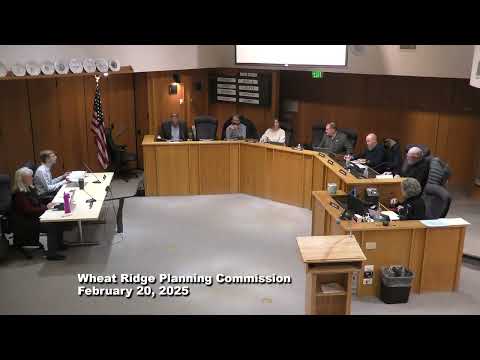
The Wheat Ridge Planning Commission voted 6-0 on Feb. 20 to recommend that City Council rezone the Lutheran Legacy campus from hospital and other residential/commercial districts to the new Mixed Use Lutheran Legacy Campus (MULC) zone district.
The Wheat Ridge Planning Commission voted 6-0 on Feb. 20 to recommend that City Council rezone the Lutheran Legacy campus from a mix of planned hospital development (PhD), planned commercial development (PCD), R‑1 and R‑2 residential districts to the new Mixed Use Lutheran Legacy Campus (MULC) zone district.
Scott Cutler, a planner with the City of Wheat Ridge Community Development Department, told the commission the rezoning is city initiated and would apply one set of zoning regulations to the entire campus. "The rezoning does not include any of the surrounding neighborhoods, nor the church at the corner of 30 Eighth and Dudley," Cutler said, adding that the change is intended to implement the previously adopted Lutheran Legacy campus master plan and the MULC regulations City Council approved in January 2025.
The master plan and the MULC regulations guide future redevelopment by concentrating taller, denser buildings toward the campus center while limiting heights at the perimeter. Cutler described the voter-approved Nov. 2024 charter amendment as adjusting allowed building heights so edge areas are subject to a low-density overlay (about two to two-and-a-half stories or approximately 30 feet), white areas to a lower-density standard (about three stories or 35 feet), and central areas to a higher allowance (up to five stories).
Nut graf: The commission’s recommendation is advisory; City Council will make the final zoning decision on April 14, 2025. Commissioners cited alignment with the master plan, infrastructure requirements for future developers and opportunities for reinvestment as reasons to support the rezoning, and several public commenters and commissioners pressed for protections for the Rocky Mountain Ditch and neighborhood connections.
Supporting details
Cutler said the rezoning was pursued by the city to avoid restrictive hospital-only zoning that would block broader redevelopment after the hospital relocation to Clear Creek Crossing. The city held three public open houses, seven study sessions with Planning Commission and City Council, mailed letters to property owners within 1,000 feet of the campus, posted roughly 10 signs around the site and sent project email updates to about 389 subscribers (about an 80% open rate). He said the city received no written comments on the project portal for this hearing.
Several residents spoke about the Rocky Mountain Ditch that runs through the site. Anne Brinkman, a nearby resident and former planning commissioner, said the ditch is privately owned by the ditch company and water‑rights owners and "is not a recreational area. It is not intended to be used for recreation," stressing that downstream water users rely on continuous flow. Betty Jo Page, who identified herself as a member of the Board of Adjustment, told commissioners she is "concerned" children could access the ditch if it becomes a trail and raised safety and fencing concerns.
Commissioners and staff acknowledged the ditch company’s ownership and said any future development proposals would be referred to the ditch company for review. Staff noted some ditch companies prefer routing the ditch underground in sections or reserving a 30‑foot (or greater) easement that limits development within the channel.
Commissioner Will Kearns, who introduced the rezoning item and moved the motion to recommend approval, read the city‑initiated motion and cited five findings including that the rezoning would promote public health, safety and welfare; require future developers to upgrade infrastructure; align with adopted plans (the Lutheran Legacy master plan and MULC regulations); provide reinvestment opportunities; and meet code criteria for zone changes. Daniel Gravy seconded the motion. The commission then voted 6 to 0 in favor of recommending approval.
Commissioners’ comments at and after the vote stressed several implementation priorities: preserving and restoring mature trees on the campus, encouraging adaptive reuse of existing hospital buildings where feasible, pursuing a mix of housing types including affordable units, integrating multimodal and pedestrian connections to disperse traffic, and protecting the Rocky Mountain Ditch and its water rights.
City Council action and next steps
Planning Commission’s recommendation will be transmitted to City Council, which is scheduled to consider the rezoning on April 14, 2025. If City Council approves the zoning, future development applications on the campus will be required to meet the MULC regulations (the 50‑page code text adopted in January 2025) and to coordinate with utilities, the ditch company and other review agencies.
Ending
The commission closed the public hearing after public comment and moved the recommendation forward. Commissioners and staff said they expect more detailed site‑specific development proposals and public review as the campus moves toward private redevelopment.
Votes at a glance
- Case WZ2502 — City‑initiated rezoning of Lutheran Legacy campus to Mixed Use Lutheran Legacy Campus (MULC). Motion to recommend approval moved by Commissioner Will Kearns; seconded by Daniel Gravy. Outcome: recommendation approved by Planning Commission, 6–0. Final decision: City Council scheduled for 2025‑04‑14.