Get email alerts on the Strategic Planning topic
No spam. Unsubscribe anytime.
PHB members press for clarity on draft strategic plan — ask for methodologies, definitions and stronger alignment
Summary
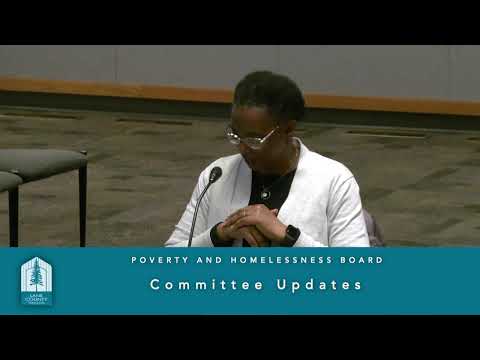
James Yum, Lane County homelessness manager, told the Poverty and Homelessness Board that the draft strategic plan — required by Continuum of Care guidance and last updated for FY2022–23 — needs clearer methodologies, consistent definitions and stronger municipal alignment before finalization.
James Yum, Lane County homelessness manager, led a broad discussion about the PHB draft strategic plan, noting a current requirement for a CoC strategic plan and that the PHB’s plan had not been updated since FY2022–23. The board spent most of the meeting asking for more detail about the plan’s numeric targets, definitions and implementation assumptions.
Why it matters: The strategic plan will guide funding and implementation priorities for county and CoC-funded homelessness services. Members said clarity on targets and methods is needed so municipalities, providers and funders can coordinate responses and measure progress.
Key points raised by the board and providers: Members asked for the methodology behind headline numeric goals in the draft (for example, the draft lists 800 new permanent supportive housing units; 1,700 new and sustained shelter/temporary housing units; and 2,500 new housing assistance opportunities). The work group and meeting participants requested clarity on whether targets represent net new units, a mixture of sustaining existing units and creating new ones, or something else; one participant asked for the basis of a $56,000,000 figure cited in the plan.
Definitions and populations: Participants said the plan should define terms that are used inconsistently — for example, what the plan means by "shelter," "temporary housing," and "medical respite" (who is eligible, program requirements, target population). Several board members and community participants urged an explicit focus on bathroom access, youth homelessness and family/children-focused strategies; others asked for more attention to move-on strategies and landlord engagement to increase housing placements.
Process and next steps: Yum said the work group has solicited feedback and that a survey from the consultant will be distributed so all members and community stakeholders can submit written comments. He estimated that, depending on the volume of feedback, staff aim to present a revised draft no later than the June all-member meeting. Board members also suggested the PHB consider how its strategic plan could function as a coordinating document to assemble local, private and nonprofit housing and service investments into a single community picture.
Ending: Board members encouraged broad review and said staff will circulate the consultant’s survey; the work group will reconvene to review submitted feedback before a revised draft returns to the PHB.
AI generated
The text on this page is AI generated. Summaries, highlights, analysis, and video transcripts are all produced from the original source material.
AI can make mistakes, so if you spot one, and we will fix it for everyone.
Note: the source content is unaltered by us. Any content source we link to, be it a video, an audio recording, or a document, is presented exactly as its publisher released it. That publisher is usually a government body, sometimes an individual official or another organisation.