Get Full Government Meeting Transcripts, Videos, & Alerts Forever!
Get email alerts on the Landmark Designation topic
No spam. Unsubscribe anytime.
Evanston preservation panel votes to encourage landmark nomination for Lorraine H. Morton Civic Center
Summary
The Evanston Preservation Commission unanimously voted to encourage a local landmark nomination for the Lorraine H. Morton Civic Center at 2100 Ridge Avenue after a public hearing and staff overview of the nomination process, interim protections, tax-credit incentives and cultural significance including women's and Black history ties.
The Evanston Preservation Commission voted unanimously Wednesday to encourage a local landmark nomination for the Lorraine H. Morton Civic Center at 2100 Ridge Avenue.
The move follows extensive public comment and a staff overview of the local landmark nomination process, interim protections and potential consequences and benefits, including federal and state historic tax credits and landscape protections.
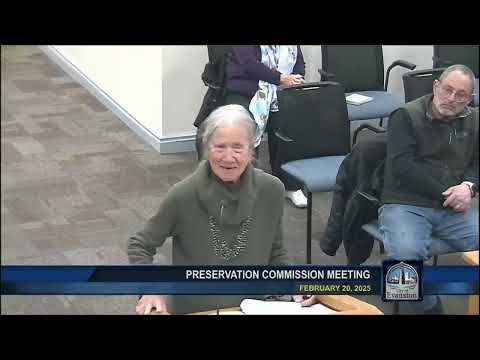
Supporters said the building is significant for multiple reasons beyond its Georgian architecture: its long public use, documented architectural provenance and a history tied to women’s education and local Black civic leadership. "I strongly endorse the designation of this building as a local landmark," said John Kennedy, a resident who spoke during the public-comment portion. "This structure has grown to be part of our historic heritage." Joan Safford, a long-time Evanston resident, urged commissioners to consider the building’s women’s-history connections and detailed research compiled by Mary McWilliams.
Commission staff member Cade (preservation staff) outlined how the local nomination process works: any resident, a commissioner, a member of city council, the mayor, a nonprofit headquartered in Evanston or an owner of record can initiate a nomination; once a nomination form is filed the property receives interim protections while the commission schedules a public hearing. "The interim protections essentially, until the property a decision has been made by either the commission or the city council, it in all intents and purposes acts as if it is a landmark already," Cade said.
Commissioners and preservation advisers discussed technical and policy issues at length. Kate (preservation consultant/staff) noted the building is already listed on the National Register of Historic Places and explained how federal and state rehabilitation tax credits typically drive adaptive-reuse projects. "The value of the tax credits is probably anywhere between $10 to $15,000,000," Kate said, adding that developers pursuing those credits must meet the Secretary of the Interior’s standards and are subject to detailed review by the State Historic Preservation Office (SHPO).
Commissioners debated what a local designation would and would not do. Several commissioners stressed that National Register listing does not by itself require a local review of exterior work and therefore would not guarantee the Commission a role in future exterior changes. A local landmark, by contrast, would require a certificate-of-appropriateness process for exterior work and could include written guidelines or a list of character-defining features to guide future decisions.
Speakers also recommended specific emphases for a nomination: codifying the civic center’s women’s-history significance (including its earlier life as Marywood/Visitation schools and ties to local Black women leaders such as former Mayor Lorraine H. Morton), documenting the building’s architectural provenance (research attributing major elevation work to an Indiana firm), and considering the surrounding cultural landscape and mature trees as part of the designation. Commissioners discussed the practical limits of landscape protections under current city code but noted the nomination and accompanying guidelines can identify sensitive areas and locations more appropriate for change.
Participants also discussed timing and process. Cade summarized statutory windows in local practice: the commission typically has 90 days after a nomination is filed to hold a public hearing, 70 days after closing the hearing to prepare findings of fact, and city council then has 120 days to act on a commission recommendation. Speakers noted the parcel’s property-identification-number (PIN) has been split and that the adjacent parkland is intended to remain open space; that split may affect how a local designation treats the landscape versus the building parcel.
The commission concluded the special meeting by taking a formal, symbolic step: a motion to "encourage the landmark nomination" for the Lorraine H. Morton Civic Center at 2100 Ridge Avenue was made and seconded and passed unanimously. The vote was recorded by the chair as unanimous in favor. Commissioners directed staff to contact Mary McWilliams — described in meeting comments as the researcher who previously prepared a nomination draft — and to consider forming a subcommittee or working group to assist with the nomination. Commissioners also discussed preparing a short memo or coordinating testimony to share the commission’s discussion with the City Council and the city manager’s office.
The commission did not take any action that would bind the city’s ownership or the RFP process; several participants encouraged cooperative engagement with the city manager’s office and consultants currently working on an RFP called "Putting the Assets to Work," which aims to study adaptive reuse and revenue options for several city properties. Commissioners emphasized that landmark designation is compatible with adaptive reuse and widely used incentives: a local designation would add a local review step for exterior alterations but would not, members said, prevent sensible rehabilitation that uses federal, state or county incentives.
The commission will follow up by reaching out to Mary McWilliams about using her research for the formal nomination, considering a subcommittee to shepherd the application, and preparing communications to City Council. The nomination form, if filed, would trigger interim protections while the commission proceeds with hearings and findings of fact.
What’s next: the Preservation Commission and staff plan outreach to the original researcher, may form an evaluation subcommittee, and discussed preparing a memo to City Council and offering commissioners’ testimony when the city’s RFP consultants publish findings or when council considers the nomination.