Get Full Government Meeting Transcripts, Videos, & Alerts Forever!
Get email alerts on the Everglades Restoration topic
No spam. Unsubscribe anytime.
Guest speaker tells Fort Myers Beach advisory committees Everglades restoration is key to reducing harmful discharges
Summary
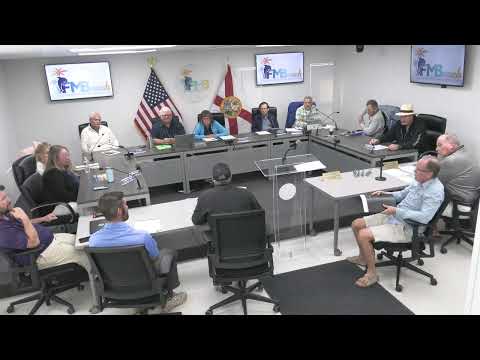
Captain Chris Whitman, co‑founder of Captains for Clean Water, told a joint meeting of the Anchorage Advisory Committee and the Marine and Environmental Resource Task Force in Fort Myers Beach that restoring historic flows to the Everglades is the most effective way to reduce freshwater discharges from Lake Okeechobee that damage the Caloosahatchee estuary and local beaches.
Captain Chris Whitman, co‑founder of the nonprofit Captains for Clean Water, told a joint meeting of the Anchorage Advisory Committee and the Marine and Environmental Resource Task Force in Fort Myers Beach that restoring historic flows to the Everglades is the most effective way to reduce freshwater discharges from Lake Okeechobee that damage the Caloosahatchee estuary and local beaches.
Whitman, who described how repeated freshwater “blowouts” have killed seagrass and oyster beds and driven away tourists and fishing clients, said Everglades restoration projects now under construction will progressively reduce damaging discharges. “We are at the hump of it,” Whitman said. “If funding stays consistent … I would estimate, you know, late thirties” for broad completion, and he said the Everglades Agricultural Area (EAA) reservoir and associated engineered wetlands could cut discharges by roughly 60–80 percent in years when projects are operating as designed.
The nut graf: Fort Myers Beach officials and residents depend on a healthy estuary for tourism and fisheries, and Whitman emphasized that infrastructure projects to change timing, conveyance and treatment of water south of Lake Okeechobee — paired with steady state and federal funding — are central to protecting local water quality and the island’s economy.
Whitman summarized the problem as a century‑old change to Florida’s hydrology: canals, levees and the Herbert Hoover Dike altered southward flow from Lake Okeechobee, concentrating excess freshwater and legacy nutrients that are released to the Atlantic and Gulf coasts in large, prolonged discharges. Even clean freshwater can kill saltwater seagrass and oysters by sharply lowering salinity, he said: “If you had a saltwater aquarium and you took all the salt out of it, even if the water is clean, everything dies.”
He described the Comprehensive Everglades Restoration Plan (CERP) as a 68‑project effort jointly funded by the state and federal governments that reconnects and meters historic flows. Whitman said more than 55 of those projects are now under construction, including bridge replacements on Tamiami Trail to restore flow, pump stations, a 6,500‑acre filter marsh (stormwater treatment area) and the large EAA reservoir that will store wet‑season water for controlled release.
Whitman and committee members discussed near‑term results from management changes and constructed projects. He said rehabilitating the Herbert Hoover Dike and a new Lake Okeechobee regulation schedule (LOSOM) have already contributed to an average reduction in damaging coastal discharges, and that incremental gains occur as projects come online. He noted measured reductions in peak flow and cited current flows through the Franklin Locks in the low thousands of cubic feet per second as more favorable than the extremes seen during recent “water crises.”
The economic case for restoration also was a focus. Whitman cited a study limited to Lee, Collier and Charlotte counties that estimated large short‑term losses during the 2018–19 water crisis: about $17.8 billion in lost property value, $5.2 billion in lost economic output, $60.3 million in lost property taxes, $8.1 billion in lost outdoor recreation value and roughly 43,000 lost jobs during the acute event. He told committee members that elected officials and local businesses are high‑value advocates in Tallahassee and Washington because their voices carry political weight.
Committee members raised related water‑quality questions, including local stormwater drainage, septic systems, beach renourishment and red tide. Whitman acknowledged those local factors contribute to water quality but said Lake Okeechobee discharges are the dominant driver of the acute, wide‑area events that knock back fisheries and tourism. “Florida’s dying from a thousand paper cuts,” he said, but “the heart of what’ll shut us down … is those Lake Okeechobee discharges.”
On remedies beyond large projects, Whitman supported education and civic engagement, urging the committees to learn available resources, ask candidates and policymakers about water plans, and circulate materials from Captains for Clean Water and partner groups. He agreed to provide a resource packet and said the organization would share scientific and economic studies referenced during the talk.
The meeting ended without formal votes. Committee chairs and staff said they would pass Whitman’s resource list to council members and circulate the referenced studies to committee members for future deliberation.
Ending: The committees heard a range of technical and policy questions and asked staff to circulate Whitman’s resource document and cited studies so members can consider specific policy or advocacy steps at later meetings.