Get Full Government Meeting Transcripts, Videos, & Alerts Forever!
Get email alerts on the Teacher Loan Assistance topic
No spam. Unsubscribe anytime.
Committee hears expansion to loan‑assistance program that prioritizes impacted schools but allows leftover funds statewide
Summary
House Bill 509 would prioritize beginning teachers in impacted schools for the Quality Educator Loan Assistance Program and allow unused funds to be awarded to other beginning teachers; proponents said the change would increase participation without increasing the appropriation.
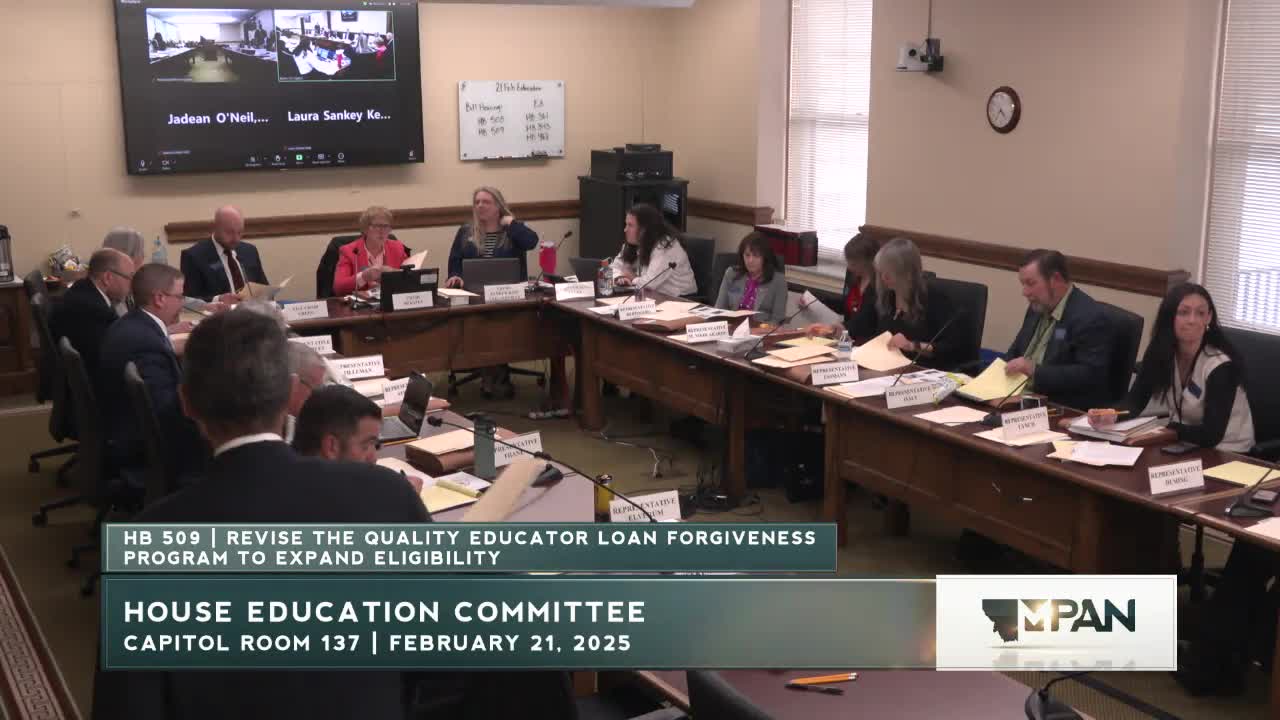
Representative Deb O. Powers opened the hearing on House Bill 509 and described the bill as an effort to improve Montana's Quality Educator Loan Assistance Program by preserving priority for teachers in impacted schools while allowing leftover funds to be used for beginning teachers elsewhere in the state.
"This bill will still give priority to beginning teachers in impacted schools that won't change. But if there is money left over in the program then it can be used for beginning teachers who apply from other parts of the state," Powers said, adding the change is intended to increase program utilization "without increasing the allocation of money to the program." She reviewed the program's history, noting the program was restarted in 2020 with an allocation and that past years have shown varying levels of fund usage.
Proponents including Rob Watson (School Administrators of Montana / Coalition of Advocates for Montana's Public Schools) and Kim Popham (MFPE) supported the change. Watson presented district survey data showing many districts rely on emergency‑authorized teachers who often do not qualify for the program, suggesting that factor depressed participation. Lissy Shaffer, a 15‑year teacher, testified she benefited from federal loan forgiveness and supported the state program's expansion.
Christie Mokstutz of the Office of Public Instruction provided details on program mechanics: the assistance is paid over a three‑year period at $3,000 in year one, $4,000 in year two and $5,000 in year three, and an optional fourth year contribution of $5,000 may be provided by the employing district. Mokstutz also said the application window is time‑limited and that, once applications are received, the agency would look at allocations to determine if funds remain to award outside impacted‑school priority. Counsel clarified that unused funds revert to the original state fund from which they were appropriated.
Supporters said the bill would let leftover (unspent) program allocations serve more beginning teachers without adding to state spending; opponents did not appear in the record and the committee did not take a final vote during the hearing. The sponsor closed by urging the committee to advance the bill so more beginning teachers could benefit.