Get Full Government Meeting Transcripts, Videos, & Alerts Forever!
Get email alerts on the Traditional Healing Medicaid topic
No spam. Unsubscribe anytime.
Senate committee hears bill to let Medicaid reimburse traditional healing services
Summary
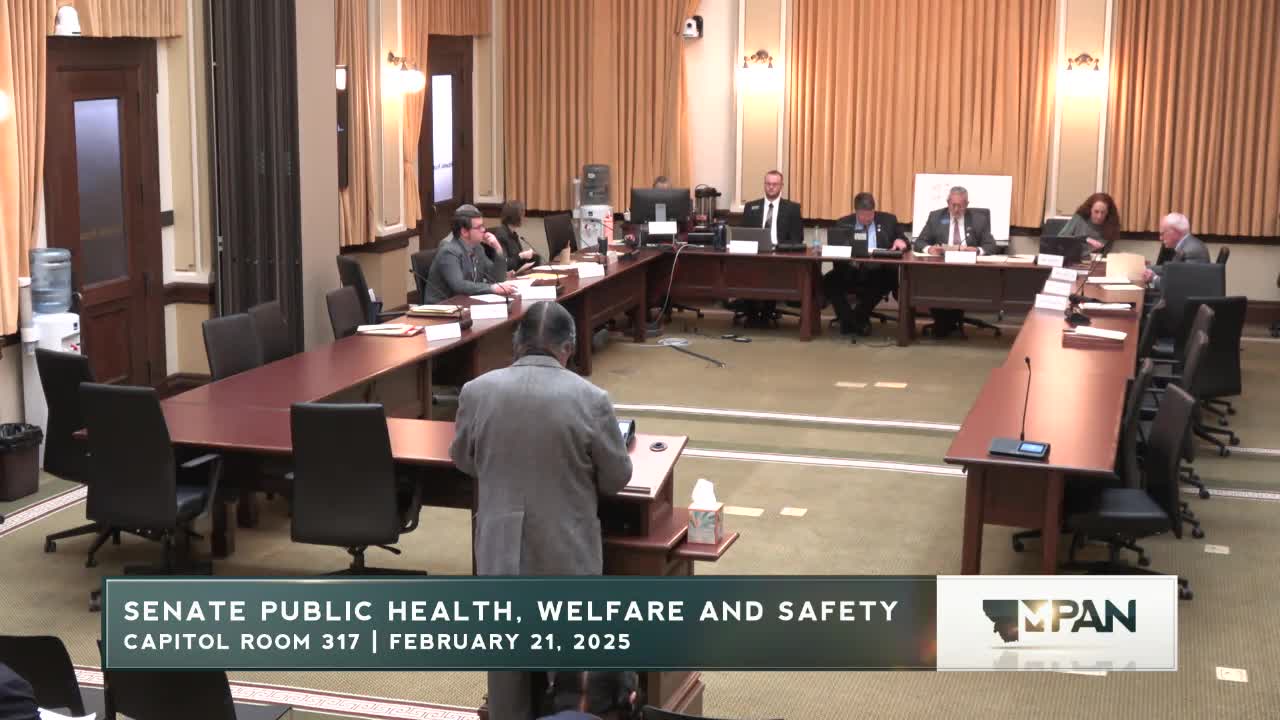
Senator Windiboy brought Senate Bill 187 before the Montana Senate Public Health, Welfare and Safety Committee to add traditional healing services and traditional healers to Medicaid-covered services, telling the committee the measure is intended to align state law with recent federal guidance for Medicaid coverage.
Senator Windiboy brought Senate Bill 187 before the Montana Senate Public Health, Welfare and Safety Committee to add traditional healing services and traditional healers to Medicaid-covered services, telling the committee the measure is intended to align state law with recent federal guidance for Medicaid coverage.
Supporters said the bill would let tribal and urban Indian health programs bill Medicaid for ceremonies and culturally specific practices that tribal communities identify as health care. "The healing process for tribal communities involves traditional ceremony and spiritual practices," Patrick Kewaukee, representing the Blackfeet Tribe, Fort Belknap Indian Community and the Chippewa Cree Tribe of Rocky Boy, told the committee. Jason Smith, executive director of the Montana Consortium for Urban Indian Health, said, "Generations of American Indians and Alaska Native people have utilized traditional healing practices to help restore and maintain health and wellness of their communities."
The bill text, as described by Windiboy, adds definitions for "traditional healing provider" and "traditional healing services," and extends community health integration services and principal illness navigation for patients at risk of hospitalization, nursing-home placement or rapid health decline. Windiboy told the committee the measure would cover services provided in Indian Health Service facilities, tribal health programs designated under the Indian Self-Determination and Education Assistance Act (P.L. 93-638) and urban Indian organizations, and said the draft could be amended to clarify coverage for additional practices such as homeopathic treatments.
Clinicians and tribal leaders detailed examples they said improve outcomes: Joel Rosette, CEO of Rockaway Health Center, said traditional practices can aid recovery from substance use disorders and improve diabetes and cardiovascular outcomes. Dr. Amy Stiffarm, director of Native American initiatives at Healthy Mothers, Healthy Babies Montana, urged support and described combining Indigenous and Western approaches as complementary. Nicole Benjamin of Rocky Vista University described a model she observed in Arizona that integrated spiritual healers and western clinicians and said outcomes improved.
Committee members focused on implementation and costs. Mary Lemieux, administrator for the Health Resources Division at the Montana Department of Public Health and Human Services (DPHHS), told the panel that adopting traditional healing into Medicaid would require administrative work and monitoring if it proceeded via a federal demonstration waiver. "The waiver has continuing pieces that we would have to manage. We would have to do quarterly reports, annual reports," Lemieux said, and noted the department's fiscal note requests an ongoing half–time FTE and includes costs for an independent evaluator and for participation by urban Indian organizations, which do not receive full federal Medicaid matching funds.
Senator Smith pressed proponents on why reimbursement was needed when communities currently provide some traditional services. "Aren't most of these things you're doing already, like sweat lodges, traditional foods, talking circles, aren't those done? And I don't know why they would need, money to do those, I guess," he asked. Sponsor Windiboy responded that many cultural protocols involve costs and that some practices—such as smoking pipes and smudging—are restricted in public medical facilities, which limits delivering those services inside certain clinical settings.
No committee vote was taken on SB 187 during the hearing; the sponsor closed the hearing after public testimony and the committee moved to an executive-action segment of the agenda. The hearing record included multiple proponents from tribal health organizations, a statewide primary-care association, hospitals and clinicians, and one DPHHS information witness who detailed the department's implementation concerns and the elements of the fiscal note.
Votes at a glance SB 250 — Motion to pass as amended (mover: Senator Ricky). The committee adopted amendment SP250.001.001 (motion recorded) and later voted SB 250 as amended out of committee. A roll-call on the amendment recorded the following votes in the transcript: Senator Ricky — yes; Senator Glynn — yes; Senator Kirk Carpenter — no; Senator Fuller — yes; Senator Yakovich — aye (by proxy); Senator Windiboy — no (by proxy); Senator Emmerich — aye; Senator McGillivray — aye (by proxy); Senator Newman — no (by proxy); Senator Smith — no. The committee announced that SB 250 "has passed out of Senate Public Health." (Amendment: SP250.001.001; outcome: approved.)
SB 251 — Motion to pass (mover: Senator Ricky). Committee reported SB 251 passed by voice vote; tally not specified in the hearing transcript. (Outcome: approved.)
SB 296 — Motion to pass (mover: Senator Ricky). Committee reported SB 296 passed by voice vote; tally not specified in the hearing transcript. (Outcome: approved.)
What happened next The committee recessed for a break after the SB 187 hearing and then carried out executive action on other bills. No final committee decision on SB 187 was made in the hearing record; proponents asked the committee for a do-pass recommendation, and DPHHS staff and several senators requested additional detail about fiscal impacts and the mechanics of any federal Section 1115 waiver needed to implement Medicaid coverage for the services described in the bill.
(End)