Get Full Government Meeting Transcripts, Videos, & Alerts Forever!
Get email alerts on the Immigration Employment Enforcement topic
No spam. Unsubscribe anytime.
Montana bill would revoke licenses of employers who hire undocumented workers
Summary
Representative Lucas Schubert introduced HB 536, seeking license revocations for entities that knowingly hire unauthorized workers and creating a state enforcement unit and private right of action; business groups and agricultural representatives warned of unintended consequences and enforcement burdens.
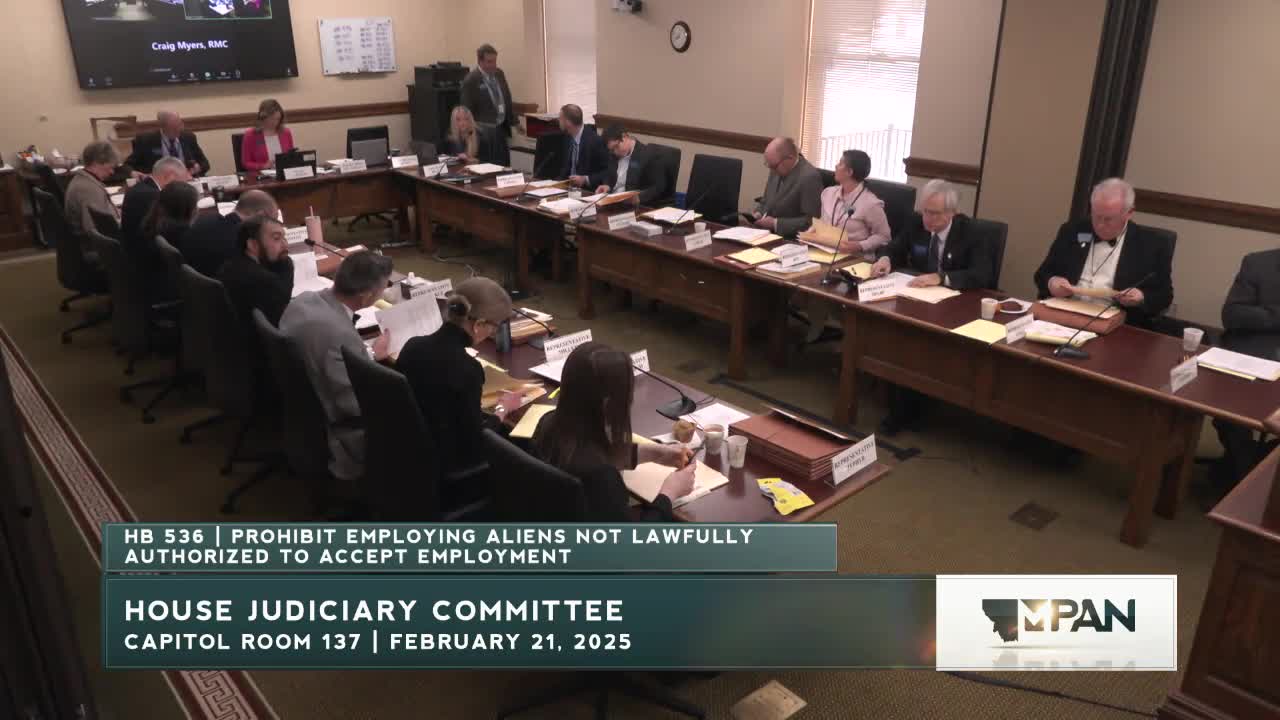
Representative Lucas Schubert introduced House Bill 536, which would revoke state licenses for entities found to knowingly hire people unauthorized to work in the U.S. and authorize the attorney general to create a statutorily appropriated enforcement task force.
The bill would impose license revocations of one year for a first offense, three years for a second offense, and 20 years for a third or subsequent offense, and would allow the state to decline to recognize licenses the employer holds from other states during a revocation. It lists various licenses “including but not limited to a business license, occupational license, driver's license, and hunting license.” Schubert said the measure would also create a private right of action allowing harmed businesses to sue competitors that underbid them by using unauthorized labor.
"My intention with this is to create a similar task force in the AG's office as the human trafficking task force except to enforce this statute," Representative Lucas Schubert said, and he told the committee the attorney general's office estimated a small task force of three to five people could be funded for roughly $2.5–3 million annually.
Proponents included Andrew Good, director of state government relations for NumbersUSA, who said cutting off the "jobs magnet" is critical to deterring illegal immigration. Good testified the group supports state-level enforcement.
Opponents included Kerry Hegerberg of the Montana Chamber of Commerce, who said the bill would in effect turn employers into immigration-enforcement agents and could “cause huge disruptions in ongoing business operations for some of Montana's smallest businesses.” Karli Johnson with the Montana Farm Bureau Federation told the committee that agricultural employers sometimes lack reliable documentation and said the bill's broad language—extending liability to those who "refer" workers—could trap rural residents who hire casual laborers.
Quinlan O'Connor, chief legal counsel for the Department of Labor and Industry, testified the department interprets the bill to reach workforce services duties such as referrals and training. He told the committee that, as drafted, those workforce activities would require an I-9 verification under the bill and could create audit and enforcement obligations for state workforce programs.
Committee members asked how the bill would treat unknowing mistakes, how violations would be counted, and why revocation would extend to licenses such as driver's and hunting licenses. Schubert said license revocation would be reserved for intentional violations and linked his approach to federal preemption concerns: because state civil and criminal penalties are preempted by federal immigration law, he said, revocation was chosen as a permitted enforcement mechanism.
Several members pressed the sponsor on unintended impacts. Representative Emily Griffith and others described scenarios—homeowners hiring informal help, farmers hiring harvest crews, or service providers relying on referrals—where workers might be hired without an employer realistically able to verify status. O'Connor agreed the bill, if enacted, would require interpretation and enforcement work by state agencies and could raise workload and scope issues.
Schubert urged a "strong due pass" vote. He repeated that licensure revocation for intentional violations would be hard to prove and, he said, limited attorney-general resources would likely focus enforcement on repeat or deliberate offenders.
The committee took no formal action during the hearing; members requested follow-up information from legal counsel in the Department of Labor and Industry and from stakeholders.