Get Full Government Meeting Transcripts, Videos, & Alerts Forever!
Get email alerts on the Board Of Investments Rates topic
No spam. Unsubscribe anytime.
Subcommittee approves Board of Investments change to working-capital treatment to keep participant funds invested
Summary
The subcommittee approved language allowing the Board of Investments to operate without a 12-month working-capital pull-down, a change the board says will keep participant assets fully invested and could return an estimated $2 million a year to the treasurer’s cash account.
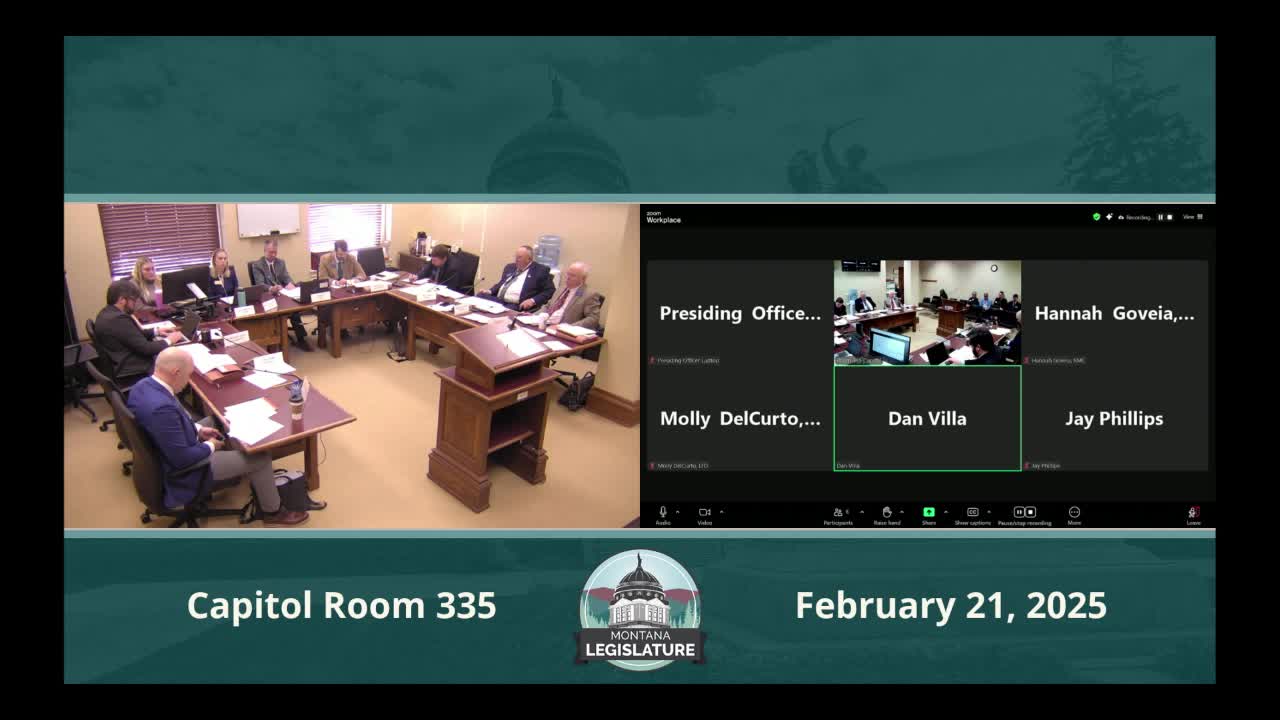
The Section A Subcommittee on Appropriations approved a change to the Board of Investments’ operating treatment that removes the requirement to pull down monthly working capital as a proprietary fund and instead allows the board to draw operating funds as needed. Board executive director Dan Villa said the change is intended to keep participant assets invested rather than holding cash idle in a short-term pool.
“[As a proprietary fund,] the board is required to pull down one-twelfth of our annual budget each month,” Villa told the committee. “When we pull that cash down…we're losing investment income for that participant every day. So what this would allow us to do is eliminate the working capital requirements, pull the money as we need it and as we use it so that all of our participants…stay fully invested as long as we can.”
Villa said the change would also allow the board to reduce charges that are assessed as rates and instead use other funding approaches; his internal projection goal was to return roughly $2 million a year to the treasurer’s cash account. Representative Walsh asked whether funds would be returned to the general fund; Villa answered that his projection was about $2,000,000 per year flowing to the treasurer’s cash account, which benefits the general fund and other state accounts.
Senator Flowers asked about legislative oversight. Villa described reporting and audit mechanisms: “Every transaction the board does on our operating budget has to be booked in SABERS. So you have the ability to see every single transaction down to where we bought our pens. … We're audited each and every year by the legislative audit division,” he said, adding that the board’s operating budget would still be visible through those records.
The committee approved the change by voice vote with Senator Harvey recorded as aye by proxy.
Why it matters: the policy alters how the Board of Investments manages operating cash and reduces the time state funds remain idle, which the board says will increase investment returns that ultimately benefit state trust and fund participants. The committee preserved oversight through accounting and audit requirements.
Next steps: the committee advanced the language; staff and the board will continue implementation details and report results.