Get Full Government Meeting Transcripts, Videos, & Alerts Forever!
Get email alerts on the Product Liability Economic Harms topic
No spam. Unsubscribe anytime.
Committee hears competing views on expanding product-liability law to economic harms
Summary
Senators heard testimony for and against adding the word "economic" to Montana's products liability statute to allow recovery for purely financial losses caused by defective digital or financial products; proponents said the change is needed for modern digital products, opponents warned it is a sweeping rewrite best considered more deliberately.
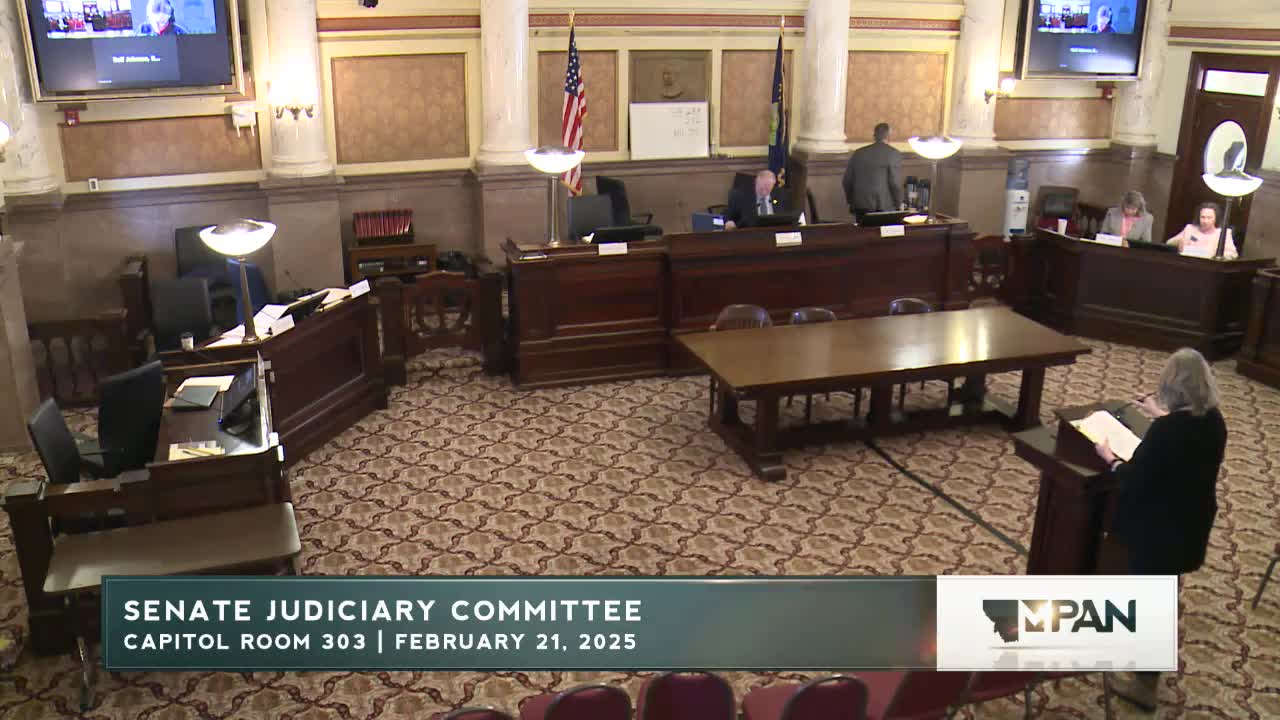
Senator Andrea Olsen opened the hearing on Senate Bill 292 by saying the bill "is adding 2 words, or economic, to several sections of the liability, products liability code" to allow recovery for financial losses from defective digital products.
The nut graf: proponents argued the change would give businesses and consumers a remedy when software, algorithms or digital tools cause financial loss; opponents cautioned that inserting two words into a decades-old statute could have broad unintended consequences and that other legal protections already exist for some harms.
John Morrison, an attorney and former Montana state auditor and commissioner of insurance and securities, supported the bill and used examples to illustrate potential harms. He told the committee that current law typically provides a remedy when tangible property or bodily injury results, but not when a defect causes only economic loss: "If there is security software ... that has a defect in it and someone hacks into your account and drains your account, you do not have a product liability case against the manufacturer of that product because your only harm is economic." He said the bill would update Montana law for the "20 first century." Al Smith of the Montana Trailers Association also supported the bill on grounds that it would compensate those who suffer financial losses and incentivize safer products.
Charles Robison, testifying for the Montana Chamber of Commerce, opposed the bill. He warned the committee that the change "is a massive rewrite" of product-liability law and urged more deliberation; he said specialized federal and state laws (including consumer protection statutes and financial-sector rules) already provide remedies in many contexts.
Committee members probed practical questions: how the bill would treat dynamic software updates and patches, whether implied warranties or the Consumer Protection Act already provide remedies, and how courts would address causation and quantification of economic loss. Morrison said some economic harms are not adequately covered by existing remedies and gave practice examples — a mispriced algorithm for valuing a totaled vehicle and a leveraged-exchange-traded fund that did not perform as expected because of errors in how it was marketed or operated.
At executive action later in the meeting, the committee voted to table Senate Bill 292. A roll-call vote to table the bill recorded five votes to table and three votes opposed.