Get Full Government Meeting Transcripts, Videos, & Alerts Forever!
Get email alerts on the Evidence Return Policy topic
No spam. Unsubscribe anytime.
Montana bill would speed return of officers' firearms after investigations
Summary
Supporters told the Senate Judiciary Committee that long evidence holds on firearms after officer-involved shootings have left small agencies without duty weapons and forced expensive replacements; bill would require faster returns once criminal or coroner investigations are complete.
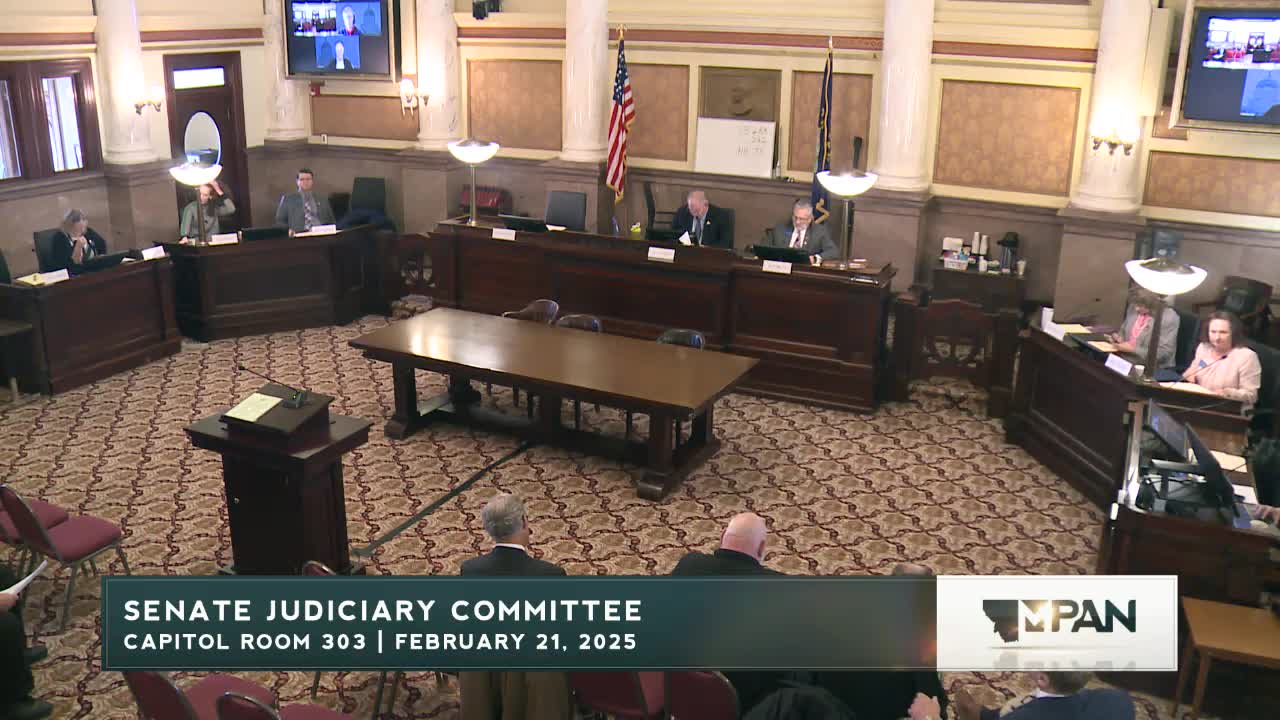
Senator Dan Loge, sponsor of Senate Bill 288, told the Senate Judiciary Committee the bill is intended to speed the return of firearms seized as evidence in officer-involved investigations so small county agencies do not have to buy costly replacement weapons. "They're not getting their weapons back in a timely fashion," Loge said, and that delay can force departments to replace rifles that can cost thousands of dollars.
The nut graf: proponents — including the Montana Police Protective Association, county sheriffs and an undersheriff — described repeated cases in which evidence holds lasted months or years, leaving small agencies short on operational weapons and forcing officers to carry personally owned firearms.
Dan Smith, executive director of the Montana Police Protective Association, said some agencies cannot afford department-issued equipment and officers use personally owned weapons. "If we release this weapon too early?" he said was his only concern, but he urged the committee to avoid evidence languishing "for years and months." Gordon Hendrick, a former mayor of Superior, described a local example: "Sometimes it's 2 years we're waiting 2 years on 1 right now on a involved shooting. We have to replace those rifles and the rifles that we use. That's $10,000 to a community that we are suffering already." Under Sheriff Wayne Cashman described two officer-involved shootings in a small agency that left deputies without department-issued weapons because seized guns were held at the crime lab.
Lee Johnson, who identified himself as the administrator with the Division of Criminal Investigation (DCI), explained how investigations route through coroner's inquests or criminal prosecutions and how that affects evidence holds. He said coroner's inquests generally conclude more quickly and that DCI's practice is to return weapons when the officer is cleared, but that county attorneys or pending criminal trials sometimes require evidence to be held longer. In response to a committee question about whether a seven-day return timeline in the draft is realistic, Johnson said, "It's realistic as long as we have a determination that the investigation is complete." He added that lab backlogs or scheduling of a coroner's inquest can delay the process.
Committee members pressed for clarity about who decides when an investigation is complete. Johnson told the committee the typical decision point is the county attorney or prosecuting authority, though civil actions or other legal needs can require holding evidence longer. Senators raised concerns about whether statutory language would meaningfully change practice or simply restate prosecutors' existing discretion.
The hearing closed with the sponsor asking the committee for a "do pass" recommendation. At executive action later in the meeting the committee moved a do-pass recommendation for Senate Bill 288; the motion passed by voice vote and a proxy vote was recorded for Senator Newman.