Get Full Government Meeting Transcripts, Videos, & Alerts Forever!
Get email alerts on the Cultural Aesthetic Grants topic
No spam. Unsubscribe anytime.
Contested cuts to Cultural and Aesthetic grants draw large testimony; sponsor defends amendments
Summary
House Bill 9 funds Cultural and Aesthetic grants. Committee amendments reduced or zeroed awards for applicants that did not appear for committee testimony; many organizations and students testified against the amendments and the Montana Arts Council apologized for advising applicants that testimony was optional.
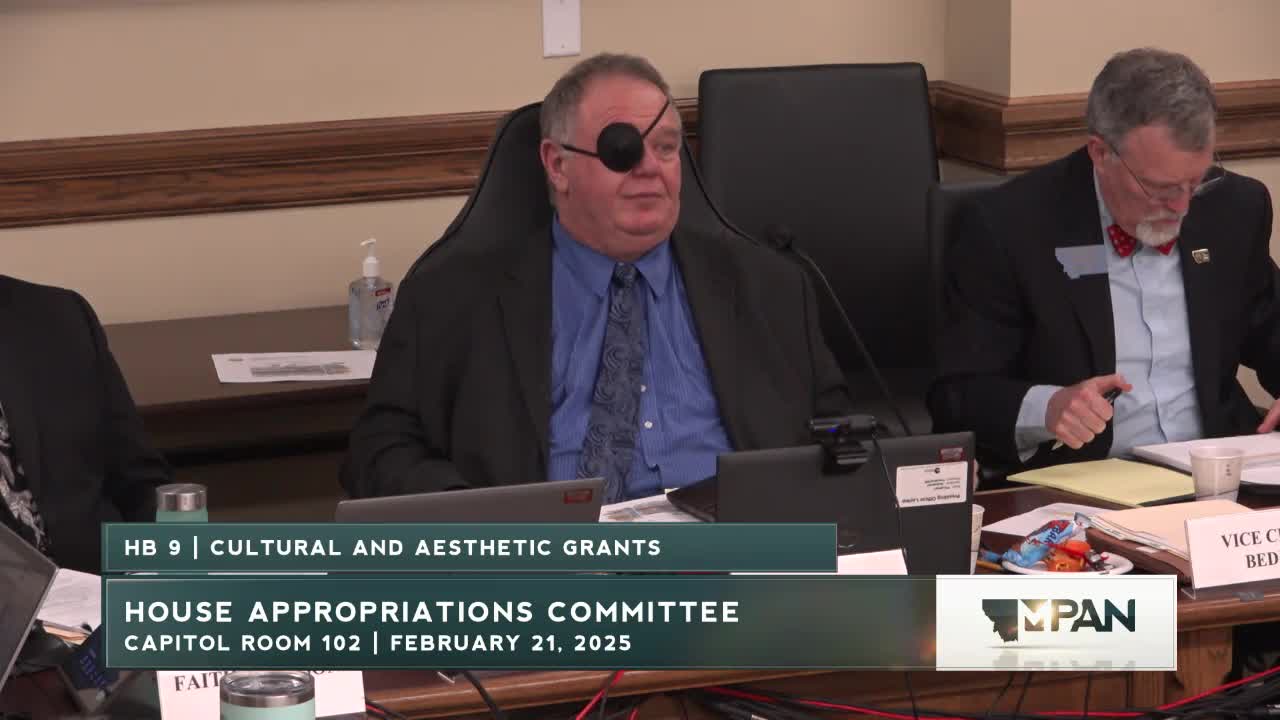
Representative John Fitzpatrick presented House Bill 9, the Cultural and Aesthetic Grant Program appropriations. He said the program originated with coal-severance allocations beginning in 1979 and that the Montana Arts Council now administers the grants. The Arts Council recommended funding for 75 applicants; Fitzpatrick described two committee amendments: (1) reduce awards for 10 applicants who submitted written testimony only to $2,000 and (2) set awards to $0 for 17 applicants who did not appear for testimony or submit supporting material. Fitzpatrick said the committee voted on the amendment that reduced or zeroed some awards in response to many applicants not showing up at hearings.
Preserve Montana’s executive director, Jenny Budenborg, asked the committee to reject the amendments and restore original allocations. Budenborg said Preserve Montana planned to use funds for an administrative position and that the organization serves the whole state. Other witnesses who opposed the committee amendments included museum and performing-arts leaders (C. M. Russell Museum, Helena Symphony, Grand Street Theater, Myrna Loy, Alberta Bair Theatre and others), program staff and youth who described scholarship and outreach programs that depend on the grant awards.
Kristen Burgoyne of the Montana Arts Council apologized to applicants and said Council staff had communicated that testimony was “strongly encouraged but not required.” Burgoyne said she had told applicants not to worry if they could not testify and that she now apologizes for assuring applicants that not testifying would not affect funding; she offered that staff misunderstood the committee’s direction and accepted responsibility for the confusion.
Representative Fitzpatrick defended the committee amendments in a lengthy close. He said the legislative process requires applicants to present and be available for questions, that many organizations with sizable budgets (several listed) did not show, and that the amendments were intended to encourage accountability to the legislature. Fitzpatrick recommended the committee keep the amendments rather than restore original awards.
The hearing drew broad, emotional testimony from arts leaders, program staff, board members, students and parents urging restoration of original awards and stressing community, educational and economic benefits of sustained support for arts organizations.