Get Full Government Meeting Transcripts, Videos, & Alerts Forever!
Get email alerts on the Reclamation Development Grants topic
No spam. Unsubscribe anytime.
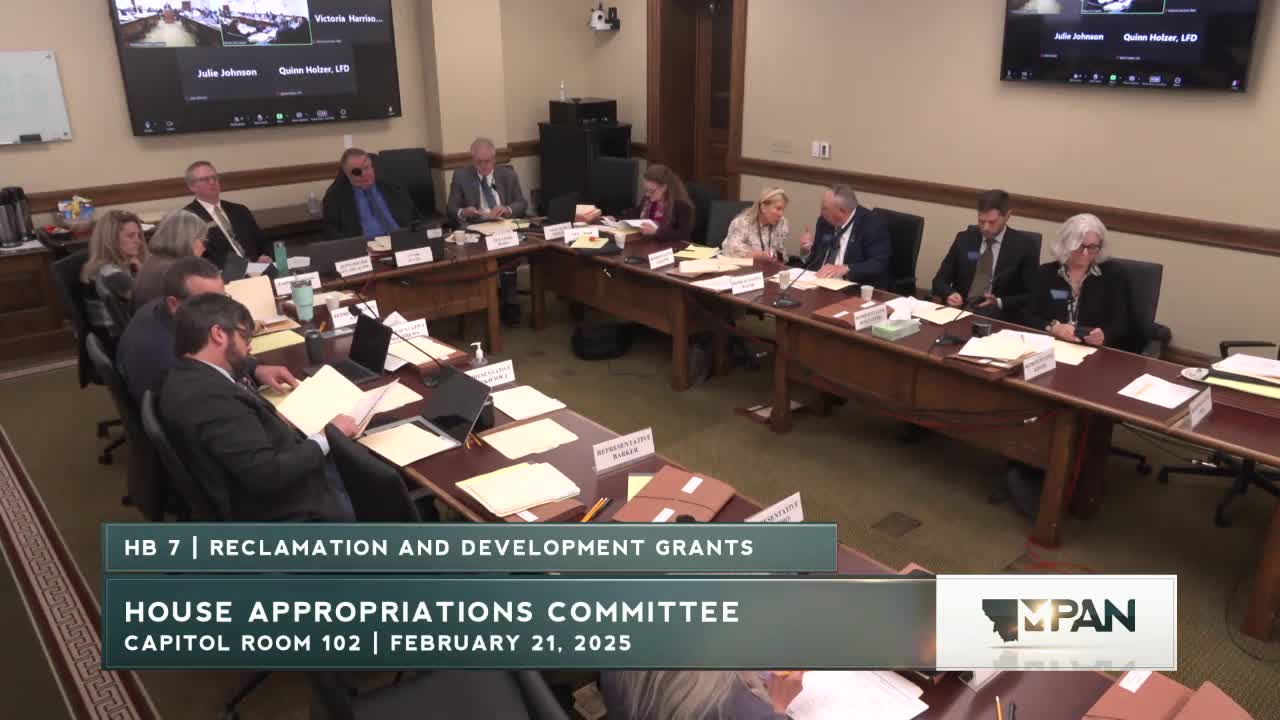
Committee hears reclamation and development grants bill; committee halves appropriations to match revenues
Summary
House Bill 7, funding reclamation and development grants (including abandoned mine reclamation, hazardous cleanups and 'crucial state need' projects), was presented by sponsor John Fitzpatrick and DNRC. The committee reduced appropriations after an updated revenue estimate; proponents urged planning grants and highlighted recent reclamation work.
Representative John Fitzpatrick, sponsor, presented House Bill 7, which would appropriate funding for the Reclamation and Development Grants (RDG) program administered by DNRC. Fitzpatrick said the program—created by the legislature in 1987—funds projects that reclaim and rehabilitate sites damaged by past human activities, excluding permitted current mining operations.
Fitzpatrick explained that project lists were adjusted because the governor's budget office reduced the revenue estimate; he said the committee moved Granite County projects lower on the priority list because they proposed no local match. The amended bill, as presented, funds through project 8 (covering the East Fork Dam Reclamation) and leaves remaining projects “below the line” pending additional revenue or failures to meet startup conditions.
Autumn Coleman (DNRC) testified that the RDG program funds abandoned mine reclamation, hazardous waste cleanups and a category the agency calls “crucial state need,” which includes drought mitigation and high-hazard-dam projects. She described recent examples: restoration of placer-mined streams (Granite and Alder Creek) and a petroleum cleanup at an abandoned gas station that threatened groundwater.
Coleman said DNRC received 17 applications totaling over $7.1 million, prioritized in statute to allocate the first $800,000 to abandoned mine reclamation. The current draft of the bill appropriates roughly $3.77 million for projects and $750,000 for planning grants to be advertised and awarded in the 2027 biennium.
Proponents including Trout Unlimited, the Montana Association of Conservation Districts and Montana Rural Water supported the bill and planning grants as essential tools for project development. Allison Corbin of the Montana Infrastructure Coalition asked the committee to restore funding for projects reduced by the committee, warning that delay raises costs.
Fitzpatrick closed by noting geographic distribution of funding and urged a do-pass recommendation.