Get Full Government Meeting Transcripts, Videos, & Alerts Forever!
Get email alerts on the Renewable Resource Grants topic
No spam. Unsubscribe anytime.
Committee advances amended renewable-resource grant list after revenue cutbacks
Summary
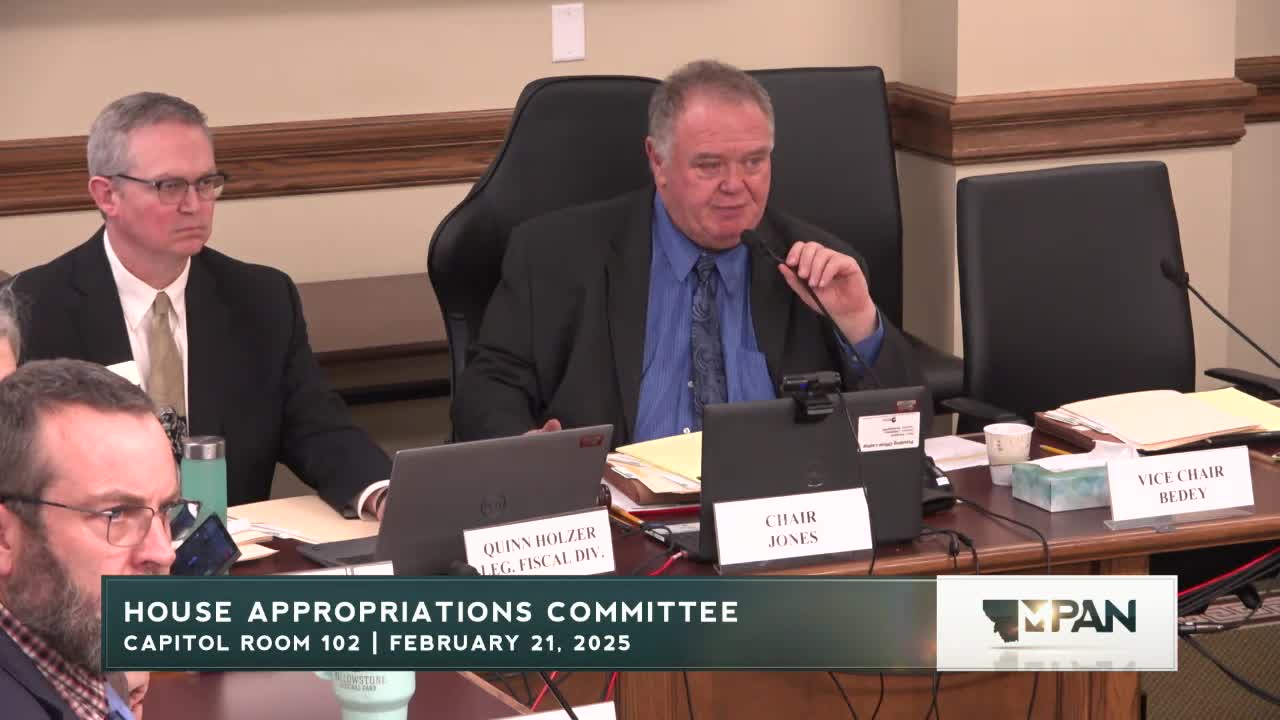
Representative John Fitzpatrick told the House Appropriations Committee that House Bill 6 contains renewable-resource grant appropriations for water, wastewater and irrigation projects and that committee amendments reduce several line items and remove a project to match available revenue.
Representative John Fitzpatrick, sponsor and member of House District 76, told the House Appropriations Committee that House Bill 6 is the subcommittee F product to appropriate renewable resource grant funds for water, wastewater and irrigation projects and to send that amended bill to the House floor.
The bill, Fitzpatrick said, was amended to reduce proposed expenditures to the level of available revenue after an error in the revenue estimate. The committee reduced several line items (for example, cuts noted in the bill from $2,000,000 to $1,000,000 and $1,000,000 to $500,000) and removed specific projects it judged infeasible. Fitzpatrick said the committee removed a Missoula library “living roof” project (project number 4) after two subcommittee members with contracting experience warned of maintenance and leak-detection problems. The amended list funds about 20 projects in the current appropriation, with additional projects remaining “below the line” pending extra revenue or failures to meet startup conditions.
Autumn Coleman, Deputy Administrator for the Conservation and Resource Development Division at the Department of Natural Resources and Conservation (DNRC), explained program structure and eligibility. She said DNRC ranks projects by measurable benefits, technical and financial feasibility and public benefits. Coleman clarified that the renewable resource grant program in this session appears in two bills: House Bill 6 (grants) and House Bill 8 (loans).
Coleman and other proponents detailed grant categories: emergency grants, planning grants, irrigation development grants (available to private individuals and governments), private homeowner grants (septic repairs), and nonpoint source pollution grants. She said DNRC received 71 applications and that the bill as presented funds 20 drinking-water/wastewater projects with approximately $2,500,000 and 21 irrigation projects with approximately $2,520,000.
Proponents including Clayton Elliott of Trident Unlimited, Rebecca Boslow King of the Montana Association of Conservation Districts, Ben Rigby of Montana Rural Water, and Cole Peebles of the Montana Water Resources Association emphasized planning grants and nonpoint-source programs as critical to preparing projects for construction and matching other federal and state funds.
Opponents and informational witnesses raised two main concerns: (1) Allison (Lisonbee) Corbin of the Montana Infrastructure Coalition asked the committee to restore reduced project funding because delays increase ultimate project costs, and (2) Tracy Campbell, Missoula Public Works superintendent, provided technical information defending the Missoula library living-roof project and described local economic benefits and modular installation details.
Committee members asked DNRC about coordination with DEQ on nonpoint-source federal funds and local matching requirements; Coleman said DNRC and DEQ plan co-administered agreements to combine state funds with federal 319 funds and to support municipal connection programs and local match requirements, unlocking additional federal funding.
Fitzpatrick closed by noting the committee's intent to spread funds geographically and recommended a do-pass on the bill as amended.