
Committee debates who controls medication decisions, reentry planning for MOUD in correctional facilities
Get AI-powered insights, summaries, and transcripts
Subscribe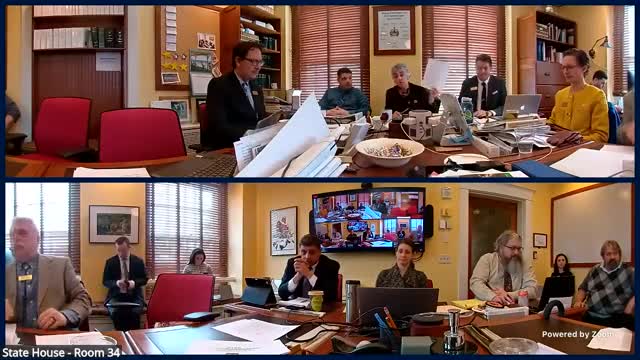
Summary
Lawmakers and agency staff continued drafting language for H.32 on Feb. 21, pressing DOC contractors and health officials on how medications for opioid use disorder (MOUD) are provided in Vermont correctional facilities and how people leaving custody are connected to community care.
Lawmakers and agency staff continued drafting language for H.32 on Feb. 21, pressing DOC contractors and health officials on how medications for opioid use disorder (MOUD) are provided in Vermont correctional facilities and how people leaving custody are connected to community care. The committee discussed who holds prescriptive authority in custody, which MOUD products should be allowed for initiation and transfer, screening timeframes, reentry planning and data collection.
The draft under consideration would keep a central clinical point of control inside the facility while preserving clinical consultation with outside providers. Tony Flom of the Department of Health’s substance‑use team said the operational practice is that "WellPath becomes the eyes and the ears" in the facility, but that hub providers may retain prescriptive authority under federal rules in hub‑and‑spoke arrangements. Dr. Yerleger (WellPath medical lead) confirmed that when someone already receives buprenorphine from a community prescriber, "the WellPath provider assumes all prescriptive authority" while consulting with the community prescriber; for methadone, federal regulations require the hub provider to maintain prescriptive control.
Why it matters: the committee aimed to align statutory language with current clinical and contractual practice while setting guardrails for continuity of care at release. Members pressed whether statute should require consultation with a community prescriber when one exists, whether the DOC contractor must offer counseling, and whether statutory language should authorize medication and short bridge supplies for detainees as well as sentenced offenders.
Screening and clinical thresholds. Committee members reviewed existing statutory screening timelines in current law: a physical assessment for inmates present at least 14 consecutive days, and a substance‑use screening within 24 hours of admission that includes opioid‑use screening and, when indicated, a Clinical Opioid Withdrawal Scale (COWS) assessment. Tony Flom described the screening sequence and its clinical purpose: the COWS helps determine withdrawal severity and whether initiating a medication risks precipitated withdrawal. The group confirmed that clinical consent remains required — individuals may refuse intake testing or treatment — and that follow‑up assessments and health evaluations commonly occur within seven days.
Which medications and when. The committee debated narrow, prescriptive language (which historically prioritized buprenorphine) versus broader language allowing "all three FDA‑approved medications for opioid use disorder" (buprenorphine products, methadone, and naltrexone). Proponents of broader language said it preserves operational flexibility and avoids repeated statutory changes as new formulations or delivery modes appear. Opponents cited operational and regulatory constraints (especially methadone’s special regulations). Multiple health system witnesses described current practice favoring buprenorphine for initiation because of its safety profile, while acknowledging methadone remains appropriate in some clinical circumstances.
Reentry planning and medication bridging. The committee returned repeatedly to reentry logistics: who prepares the plan, what medications or bridge supplies should be provided on release, and whether detainees (people in pretrial custody) should be explicitly authorized in statute to receive bridge supplies. DOC staff and contractors said current practice — reflected in the DOC contract with Wellpath — commonly provides a short bridge supply (two to five days) or arranges pharmacy pickup so someone released with little notice can get immediate medication access. The committee discussed making that authorization explicit in statute (for both MOUD and other chronic medications) and whether language should say the Department "may" provide medication to detainees to preserve operational flexibility.
Care coordination and case management. Members discussed embedding case management and health navigators to arrange follow‑up appointments with community hubs or providers before release. Monique Sullivan, an operations manager overseeing casework, described current practice that casework should begin on day one and that, for people on supervision (e.g., parole), probation and parole offices continue case management; people who "max out" a sentence receive less continuity from DOC. The group discussed the Vermont Chronic Care Initiative (VCCI) and the 1115 waiver, which would embed community‑based case managers at facilities and could change how reentry navigation is funded and executed.
Counseling and voluntariness. Committee members debated statutory wording around counseling: whether counseling should be "provided," "offered," or clearly voluntary. Because counseling uptake is variable and, in some past cases, linking continuation of medication strictly to therapy attendance destabilized people, several members recommended wording that counseling be offered rather than made a condition for continued medication.
Workforce, training and contractors. The committee considered whether to add statutory training requirements for DOC staff around MOUD delivery and behavioral‑health awareness. Some members favored continuing academy‑level training (including sessions by Turning Point and other recovery organizations) rather than frequent disruptive unit‑level trainings; others said limited, targeted training for frontline staff helps reduce friction between security and medical teams. Members also flagged the need for statutory language or cross‑references to ensure future contractors meet current operational standards.
Data collection and reporting. The draft bill already includes a number of requested data points for annual reporting: counts of individuals receiving MOUD in correctional facilities by medication type; 6‑month post‑release health and social outcomes; recidivism rates for those who received MOUD; and cost analyses tied to recidivism and health care spending. Witnesses recommended focusing on handoff metrics (for example, the share of people who make their first community appointment after release) as the most actionable short‑term measure. Several speakers noted data lives in multiple systems (hub reporting, Medicaid claims, all‑payer sources) and that the 1115 waiver and Medicaid claims data will improve tracking.
Outstanding policy choices. The committee did not adopt final statutory text on two principal questions: (1) whether statutory language should explicitly authorize DOC (or its contractor) to provide short bridge supplies to detainees as well as sentenced offenders (members leaned toward authorizing DOC to do so while preserving operational flexibility); and (2) whether to codify a requirement that DOC contractors consult community prescribers when an incarcerated person already has an outside prescriber (witnesses said that consultation already occurs in practice and that Vermont MOUD rules and professional boards impose coordination expectations). Members asked staff to produce revised draft language reflecting committee direction and to flag items requiring further testimony (training curriculum details, contractor performance standards, and the implementation effects of the 1115 waiver).
Ending note: committee members set follow‑up work for staff to produce statutory language that (a) preserves clinical control within facilities while ensuring community coordination where appropriate, (b) permits all FDA‑approved MOUD with operational guardrails, and (c) explicitly authorizes DOC to continue short‑term medication bridging for people leaving custody while cross‑referencing existing reentry planning and medical standards in statute. No formal motions or votes were recorded during the session.