
Legislative Council briefs House Education on statutory process for voluntary union school districts
Get AI-powered insights, summaries, and transcripts
Subscribe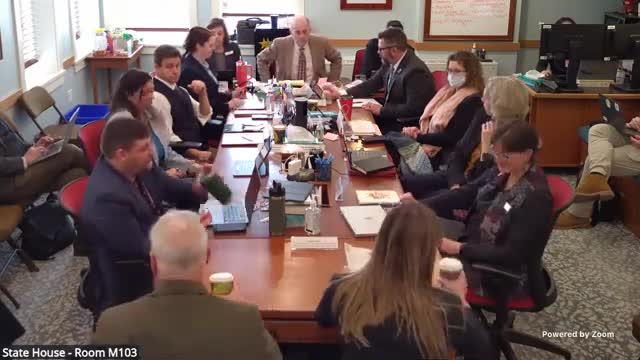
Summary
Beth St. James of the Office of Legislative Council told the Vermont House Education Committee on Feb. 21 that current state law (Title 16, Chapter 11) provides a detailed, voluntary process for school districts that want to form or join union school districts.
Beth St. James of the Office of Legislative Council told the Vermont House Education Committee on Feb. 21 that current state law (Title 16, Chapter 11) provides a detailed, voluntary process for school districts that want to form or join union school districts.
The process in statute is structured and contains multiple decision points. A study committee—established by participating school boards or by petition of voters—must prepare a report and proposed articles of agreement that explain how a new union school district would operate, how assets and liabilities would be handled, representation on the initial school board, and the proposed operational date. The law requires the study committee to analyze whether the proposed union school district would promote the state's policy of "substantially equal educational opportunities," produce operational efficiencies, and deliver services parents, voters and taxpayers value.
If the study committee votes that a union school district is advisable, it forwards its report and proposed articles to the Secretary of Education for review and then to the State Board of Education, which may request further study or changes. Only after State Board approval can the proposal be voted by the affected school districts' voters on a date specified in the articles of agreement. Those votes must be by Australian ballot on the same day in each affected district. If the necessary districts (those the study committee deems required for the union district to exist) approve the measure, the new union school district is formed and the Secretary of State files certification.
The statute builds in a transitional period: the operational date is the July 1 following approval, and until that date the forming districts continue to operate and provide education for their students. During the transition, the new union school board prepares policies, curriculum, budgets and negotiates or assumes existing collective bargaining agreements; it may also borrow limited funds to meet obligations. On or before the operational date, assets and reserve funds of the forming districts transfer to the new union school district unless the articles of agreement provide otherwise; the new district generally assumes prior liabilities, subject to limits set in the articles.
St. James told the committee that Chapter 11 contains detailed rules on representation models for the initial board, the organization meeting (which must be held within 60 days of Secretary of State certification), and how and when assets, indebtedness and reserves are carried over. The law also provides for joining an existing union, withdrawing or dissolving a union district and directs the State Board to adjust supervisory union boundaries after formation.
Why it matters: Committee members are considering statutory changes and want to understand the baseline of current law that governs voluntary mergers. St. James emphasized the committee can change these statutory procedures if it chooses; what she outlined was current law rather than mandated practice.
Committee members said the briefing showed how detailed and administratively complex voluntary mergers have been under current law, and they noted the level of local public engagement required by the study-committee and voting steps. Several members said they will review draft statutory language next week and that deeper labor-law analysis will be needed if the Legislature moves toward creating districts by legislation rather than through the existing voluntary process.