
Municipal league backs limiting appeals, supports options for adopting state preemptions and record-based review
Get AI-powered insights, summaries, and transcripts
Subscribe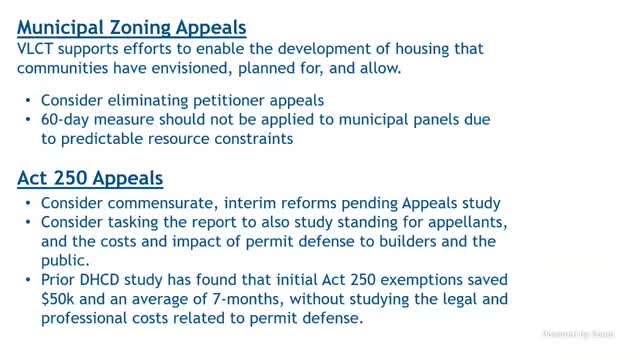
Summary
The Vermont League of Cities and Towns told the House General & Housing Committee Feb. 21 that tightening who may appeal permits and allowing municipalities to adopt certain state preemptions directly would help speed housing projects and reduce costs.
Representatives of the Vermont League of Cities and Towns told the House General & Housing Committee on Feb. 21 that streamlining appeal processes under Act 250 and municipal permitting would speed housing projects, reduce costs and help municipalities realize locally adopted plans.
The witnesses supported raising the threshold to file appeals (testimony referenced a proposed 20% threshold of population and related limits), tightening standing by requiring appellants to be an aggrieved party, and ensuring exhaustion of local administrative remedies before a case is appealed. The league cited a 2017 Department of Housing and Community Development study that found Act 250 exemptions saved two priority-housing projects roughly $50,000 in permit fees and about seven months in their timelines.
“We support the raise to 20% of the population,” Samantha Sheehan said, and the league said it has previously urged that standing be limited so that only aggrieved parties may appeal municipal permits. Witnesses also recommended expanding interim Act 250 exemptions that have produced housing while a broader study of Act 250 reforms continues.
On local adoption of state preemptions: the committee bill would allow municipalities to adopt state-prescribed preemptions into their zoning and bylaws without requiring a full local charter process; the league supported offering municipalities the option to adopt the state changes directly and suggested clarifying that regional planning commissions (RPCs) can be contracted to prepare required ordinance language and provide planning technical assistance.
On record-based review: committee members asked about options to reduce de novo review where a record exists at the local level. The league indicated support, saying developers and municipalities waste time when there is no record and suggested an option to produce a record (for example, by paying for a reporter) could be useful in limiting duplicative review.
Why it matters: witnesses argued that predictable, timely permitting and appeals reduces project costs and the administrative burden on municipal volunteers and staff, enabling projects that meet community plans to move forward.
Ending: The league asked the committee to align interim exemptions with longer-term study recommendations and to consider including standing and appeal-cost analyses in the Act 250 study scope.