
Woodland Park planning commission advances draft PUD code rewrite, favors required concept review
Get AI-powered insights, summaries, and transcripts
Subscribe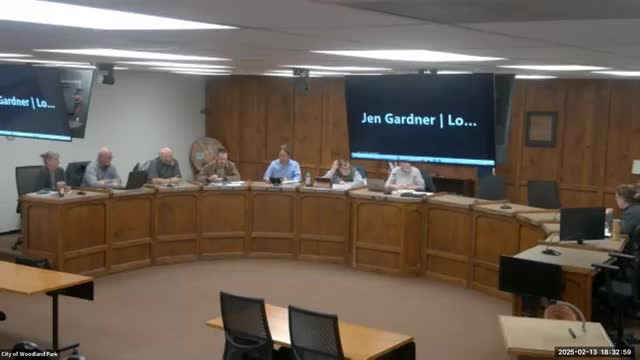
Summary
At a Feb. 13 work session, Woodland Park planning staff and a consultant presented a proposed rewrite of the city’s Planned Unit Development rules that would centralize review processes, combine preliminary and final development plans into a single general development plan submitted with a rezoning, and make an early concept review a required step.
WOODLAND PARK, Colo. — At a Feb. 13 work session, Woodland Park planning staff and a consultant continued a multi-month review of the city’s zoning and subdivision code and outlined a proposed rewrite of the Planned Unit Development (PUD) procedures that would centralize approval processes and make an early project “concept review” a required step.
The session focused on a draft Chapter 6 that staff say reorganizes process language now scattered across the code, consolidates administrative procedures, and changes the PUD review path from separate preliminary and final development plans into a single “general development plan” submitted with a rezoning to a PUD district. Planning staff said the rewrite is intended to clarify review steps for applicants and staff.
“Because PUDs allow that greater flexibility than traditional zoning, PUD procedures often emphasize detailed site planning more than in traditional zoning districts,” planning staff member Karen (city planning staff) told the commission as she reviewed statutory authority and the code sections that currently govern amendments and notice requirements, citing Section 18.69 and notice requirements in 18.72.060.
Staff and consultant Jen described the recommended workflow as three steps: an optional pre-application meeting (staff advised), a concept review to test a developer’s broad scheme against the comprehensive plan and code, and then a general development plan submitted with a rezoning application. Jen said the intention is to replace the existing preliminary/final development plan sequence with a single, clearer development plan that accompanies the rezone.
“We thought, maybe there should be in addition to a pre application meeting... a conceptual plan review where the applicant can bring in, here's my general concept,” Jen said. She described the development-plan level of detail the city would expect when rezoning a site to PUD, including general land uses, access, and open space bubbles rather than parcel-level final engineering.
Commission discussion centered on whether the concept review should be optional or mandatory and how much of the concept review should be handled by staff versus referred to the Planning Commission for initial comment. Several commissioners urged making the concept review mandatory to avoid applicants spending time and money on plans that will later be rejected on basic policy or technical grounds.
“I recommended that would be mandatory. And that is at the pre application level, you really kinda get an introduction to the project itself,” Commissioner Larry Larson said, supporting a required concept review. Commissioner Don Hoing and others voiced similar support; one commissioner said the body should be “comfortable with making it a required step” to avoid projects getting “too far down the rabbit hole.”
Commissioner Dawn Dezellem cautioned staff and commissioners to preserve the original intent of existing ordinance language when restructuring the code.
“I want to understand where those originated from or how they've been amended over time. And as much as possible, stay true to them unless we find there's a reason to recommend… change,” Dezellem said, urging careful treatment of text that was carried forward from prior ordinances.
Staff described several substantive drafting tasks still outstanding: a section describing when and how an approved general development plan may be changed (minor administrative amendments versus major amendments that would require public hearings), transition language for existing PUD approvals, and explicit submittal items. Conveio (review) comments discussed adding a requirement for applicants to provide documentation on availability of adequate city water resources, a public cost–benefit analysis (with a request for clearer guidance on what that analysis should include), whether to require an application fee for the concept review, and supplements such as estimated employment projections and homeowners-association intent.
Karen told the commission the rewrite follows state law and the Planned Unit Development Act’s intent to allow negotiated flexibility in exchange for design and community amenities. She said the code restructuring also seeks to centralize embedded process language spread across about two dozen places in zoning and subdivision chapters so applicants can more easily find procedural requirements.
Commissioners also discussed how the city will show where language was carried forward from existing ordinances. That question touches the broader choice—staff said—between treating the rewrite as a wholesale repeal-and-adopt of the chapter (which can simplify codification but may invite broader public debate) or as a restructuring that clearly marks unchanged language. Several commissioners asked staff to show “breadcrumbs” identifying substantive changes when the draft goes to public review and city council.
No formal ordinance vote was taken at the Feb. 13 work session. Staff scheduled follow-ups: the PUD rewrite and two draft ordinances for the Feb. 27 work session (including a separate ordinance addressing how the code treats availability of water for new development), with potential public hearings in March. The commission also approved the Jan. 23 meeting minutes at the start of the Feb. 13 session (motion carried; five yes, one abstention).
What’s next: staff will incorporate the commission’s direction—including making the concept review mandatory and clarifying submission and amendment procedures—produce a revised draft that flags substantive changes, and return the draft for further review at the Feb. 27 work session and subsequent public hearings.
(Quotes above are verbatim excerpts from the Woodland Park Planning Commission Feb. 13, 2025 meeting transcript.)
Ending
Staff will redraft language on concept-review requirements, plan-change procedures, transition provisions for existing PUDs, and submission checklists (including suggested water-availability and economic items) and return with a marked-up draft for the commission’s Feb. 27 work session; the commission’s comments will guide a subsequent public hearing process at city council.