Get Full Government Meeting Transcripts, Videos, & Alerts Forever!
Get email alerts on the Transportation Funding topic
No spam. Unsubscribe anytime.
California panel begins work on road-charge pilot called for in SB 1077
Summary
The newly formed Technical Advisory Committee met Jan. 23, 2015, to begin designing a road‑charge pilot required by Senate Bill 1077, focusing on privacy, feasibility and timelines including a pilot implementation deadline of Jan. 1, 2017.
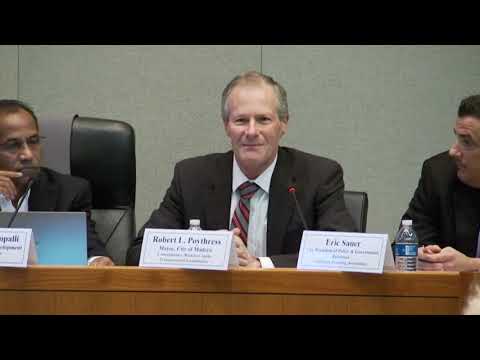
The California Road Charge Technical Advisory Committee met for its inaugural session on Jan. 23, 2015, to begin work on designing a pilot program required by Senate Bill 1077 and assigned to the California Transportation Commission. The meeting opened with remarks from Will Kempton, executive director of the California Transportation Commission, and Chair Madaffer, who presided over roll call and introductions.
The committee was created by Senate Bill 1077, which requires the commission, in consultation with the California State Transportation Agency, to develop and evaluate a pilot program testing mileage‑based revenue collection as an alternative to the gas tax. Carrie Porvitti, deputy director and commission program manager, summarized the law’s central deadlines: the Transportation Secretary must implement a pilot no later than Jan. 1, 2017; the state agency must report findings by June 30, 2018; and the Commission will include recommendations in its annual report by Dec. 15, 2018.
The committee will be supported by California Transportation Commission staff, Caltrans technical staff and consultants; SB 1077 also requires the TAC to consult with highway users, vehicle manufacturers, fuel distributors and other stakeholders. The statute explicitly directs the committee to consider privacy and data security, including “location data,” and to examine at least one collection method that does not rely on vehicle location information.
In a technical briefing, Steven Keck, division chief of Caltrans budget, warned that California’s excise‑tax based system has not kept pace with inflation and rising fuel efficiency. Keck said the state’s base gas excise tax has not increased since 1994 and that “the value of the tax has been much greater ... and in fact the value of the tax since 1994 has decreased about 65%” in purchasing power; he reported the inflation‑adjusted value at roughly 7.8¢ per gallon. Keck also highlighted that improving vehicle fuel economy and future increases in miles traveled could further widen the gap between system use and revenue.
Brian Annis, undersecretary at the California State Transportation Agency, summarized a recent administration white paper from the California Transportation Infrastructure Priorities work group. He said the group’s advisory membership endorsed recommendations overwhelmingly in an anonymous poll (42 of about 45 respondents endorsed the recommendations), while noting some members were skeptical about public acceptance and collection costs. Key work‑group recommendations cited by Annis included robust public engagement, strong privacy protections, user choice among reporting options, geographic diversity in the pilot and an emphasis on keeping the system simple and cost‑efficient.
The meeting also included a legal briefing by George Spanos, counsel to the California Transportation Commission, on the Bagley‑Keene Open Meeting Act and the committee’s public‑meeting obligations. Spanos reminded members that materials distributed to a majority relating to agenda items may be subject to disclosure under the Public Records Act and warned against serial meetings and informal communications that could create an unposted majority consensus.
The committee agreed on an initial mission statement to “identify and design an equitable gas‑tax replacement pilot program” through an open forum and discussed operating procedures and a 2015 meeting schedule. Staff proposed a clarifying amendment to the procedures that would allow removal of any member missing three meetings, “at the discretion of the chair” to account for legislative members’ schedules.
The meeting packet and staff slide deck are available via the California Transportation Commission website; the session was webcast.
Looking ahead, commission staff and the Transportation Agency will move toward pre‑implementation activities in 2016, including procurement, outreach and participant enrollment for the pilot, while the TAC will continue to monitor and provide public forums throughout implementation and reporting.