Get Full Government Meeting Transcripts, Videos, & Alerts Forever!
Get email alerts on the Road Usage Charge topic
No spam. Unsubscribe anytime.
Washington Transportation Commission outlines phased road-usage charge work plan
Summary
Bridal Griffith, executive director of the Washington State Transportation Commission, told California’s advisory committee that Washington’s multi-year study finds a transition away from a consumption-based motor fuel tax is feasible but complex, and that careful, phased demonstrations and consistent public education will be necessary before any policy change.
Bridal Griffith, identified in the meeting as executive director of the Washington State Transportation Commission, told California’s Road Charge Technical Advisory Committee that Washington has followed a deliberate, multi-year process to assess whether and how to transition from a consumption-based motor fuel tax to a road-usage charge.
Griffith said the work began in statute in 2012 and has proceeded in phases — an early feasibility assessment, a business-case analysis, and later development of a concept of operations and a demonstration plan. She told the committee Washington’s motivation includes a financing constraint: about 70% of the state’s current gas-tax revenue is committed to long-term debt over the next decade, and vehicle fuel-efficiency gains threaten future consumption-based revenue.
The commission’s process has relied on a 25-member stakeholder steering committee mandated by statute and a sequence of public- and policymaker-facing activities. Griffith described three broad outreach phases: limited public briefings while the technical work matured; targeted presentations and public surveying to take the pulse of informed opinion; and, if approved, a demonstration phase that would deploy active focus groups, regional pilots and more intensive media engagement.
Washington’s analysis has used household-level survey data and Department of Licensing fleet data. Griffith said the commission’s online survey panel attracted roughly 8,000 participants statewide and produced county-level samples that helped identify distributional effects. The commission’s analysis found that differences in outcomes across counties correlated more with what people drive than where they live: rural counties in Washington tended to have a higher share of larger, lower-mpg vehicles, which the commission’s modeling indicated would generally see modest cost reductions under a per-mile approach, while urban drivers in more fuel-efficient vehicles could see small increases.
Griffith outlined four operational approaches Washington has been using to frame policy choices:
- A time permit (flat fee for a period); - An odometer-read method (annual or registration-period reconciliation); - An automated distance charge using in-vehicle technology able to distinguish in-state public-road travel from private or out-of-state travel; and - A smartphone-based application that functions like the automated approach but uses the phone as the mileage proxy.
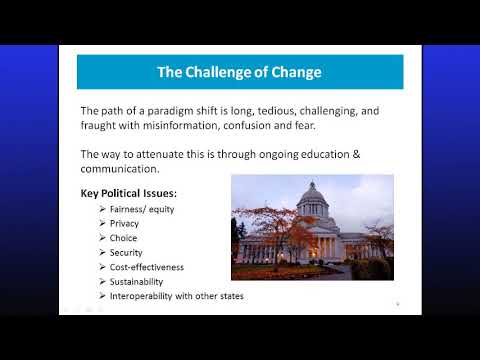
She emphasized choices intended to protect privacy, to preserve options for motorists who do not want in-vehicle technology, and to maintain interoperability with other states. On privacy and data security, Griffith said the commission learned from Washington’s tolling experience: strong statute and contract protections, explicit limits on permitted uses of data and heavy penalties for misuse are all essential. “There’s a lot of misinformation, a lot of fear embedded in it,” she said, arguing that consistent, factual public communications are key to advancing the idea.
Griffith also discussed costs and timing. Washington’s early financial analyses considered net revenue (after collection costs) and included conservative assumptions about program overhead. She said collection costs for a mileage-based system are expected to exceed those for the current gas-tax system, and that the commission has recommended caution about bonding (using gas-tax receipts as collateral) so future financing remains flexible.
On next steps, Griffith said Washington had reported to its legislature and requested approval to proceed into demonstration planning. The demonstration Washington proposed would be focused, she said, and would test multiple collection options and communication strategies across regions; she described a potential demonstration of roughly 12 months’ active data gathering, involving multiple regional samples and cross‑state coordination with Oregon and California.
The presentation made clear the commission’s goal: identify a long-term, sustainable funding approach that transitions away from a pure consumption tax while addressing equity, privacy, security, enforcement and interoperability.
Ending: Griffith left the committee with two practical recommendations for California policymakers: build a phased plan that separates policy design from public demonstration; and invest early in communications and stakeholder education to reduce misinformation and build a common knowledge base among elected officials, stakeholders and the media.