Get Full Government Meeting Transcripts, Videos, & Alerts Forever!
Get email alerts on the Electrical Undergrounding Guidelines topic
No spam. Unsubscribe anytime.
Office of Energy Infrastructure Safety adopts 10-year electrical undergrounding guidelines under SB 884
Summary
The Office of Energy Infrastructure Safety adopted guidelines to govern voluntary 10-year electrical undergrounding plans required by SB 884, setting project-selection standards, a four-screen decision framework, required risk-model transparency and detailed data reporting requirements for utilities seeking approval.
The Office of Energy Infrastructure Safety (Energy Safety) adopted guidelines on Feb. 20, 2025, that set how large electrical corporations will prepare voluntary 10-year electrical undergrounding plans under Senate Bill 884. Kristin Ralph Douglas, program manager of the Electrical Undergrounding Division, opened the meeting and announced the formal adoption.
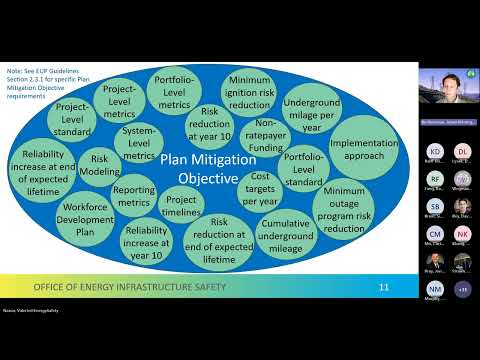
The guidelines require utilities to set a Plan Mitigation Objective (PMO) that demonstrates a substantial reduction in wildfire ignition risk and a substantial increase in reliability over the 10-year program. "SB 884 places a significant burden on utilities to, quote, show substantial reduction in wildfire risk and show substantial increase in reliability," Kristin Ralph Douglas said during the presentation.
Why it matters: the guidelines establish how utilities must prioritize circuit segments for undergrounding, how they must compare undergrounding to alternative mitigations, and what data they must submit so Energy Safety and the public can track progress over a decade. Energy Safety said the requirements aim to direct limited funds to circuit segments that yield the largest risk reduction per mile.
Key provisions and technical requirements
- Project goals and standards: Each utility plan must include a PMO (the plan-level goal), project-level thresholds and standards, and a portfolio-level standard measured on a per-mile basis. The portfolio standard must separately measure ignition-risk reduction and reliability increase so that selected projects demonstrate both per-mile effectiveness and cumulative impact.
- Four-screen project acceptance framework: Utilities must explain how they will select projects using a sequential four-screen framework. Screen 1 limits consideration to circuit segments that are location-eligible (tier 2 or 3 high fire-threat districts or wildfire rebuild areas) and meet a minimum risk threshold. Subsequent screens require alternative-mitigation comparisons, detailed scoping analyses, and a final prioritization screen that considers wildfire risk reduction, public safety, cost efficiency, reliability benefits and completion time.
- Alternative mitigations and comparisons: For each candidate project, the utility must compare undergrounding with at least two alternative mitigation combinations (for example, above-ground hardening such as covered conductor and additional protections such as FASTrip as described in the guidelines) and compute cost-benefit ratios using the California Public Utilities Commission (CPUC) methodology referenced in the presentation.
- Robust, transparent risk modeling: Utilities must disclose the risk-modeling methodology used to quantify likelihood and consequences of utility-associated wildfires and outage programs. The guidelines require model reports and a set of Key Decision-Making Metrics (KDMMs) at system, portfolio and project levels (including instantaneous and cumulative ignition risk and outage-program risk) and require baseline and backtesting capability.
- Granular data and reporting: The guidelines specify data formats and regular reporting. Utilities must submit an initial plan and then progress reports every six months if a plan is approved. Required submissions include 15 CSV tables, 2 JSON files and 6 GIS feature classes. The submission structure is organized into plan-level tracking, circuit-segment and confirmed-project records, subproject construction records, and a consolidated project summary table intended for stakeholder access.
Public comment and agency response
PG&E (spelled in the transcript as "PG and E") offered a public comment during the meeting. Meghan Ardell of PG&E said the company "appreciates Energy Safety's work in developing and adopting these guidelines" but noted ongoing challenges and requested clarity on the timeline and compliance guidelines that will govern utilities' commitments and evaluation over the 10-year period.
Energy Safety staff acknowledged the public comment record and described a multi-stage public comment process that preceded adoption: workshops, draft revisions and two public workshops for revised drafts. Curtis Moe, a utilities engineer, summarized the public engagement and thanked stakeholders for their input.
Adoption and next steps
At the close of the meeting, Energy Safety announced the guidelines were adopted. Valerie Naren, an analyst on the SB 884 team, said a clean version of the final guidelines and slides and a recording of the meeting will be published on Energy Safety's website and filed to the EUP docket via the e-filing system with service to the service list by the end of day Feb. 20, 2025.
The Office of Energy Infrastructure Safety will use the guidelines to evaluate any 10-year voluntary plans submitted by large electrical corporations; approval requires utilities to meet the PMO and the portfolio and project standards using the transparent decision-making and data reporting approaches described in the guidelines. The guidelines also require ongoing six-month progress reports and public model-reporting to permit external review of assumptions and risk-model changes over time.
Notes: The guidelines repeatedly reference SB 884 and the CPUC cost-benefit ratio methodology; the guidelines themselves and the SB 884 statute are the controlling documents cited by Energy Safety staff in the presentation.