Get Full Government Meeting Transcripts, Videos, & Alerts Forever!
Get email alerts on the Transportation Funding topic
No spam. Unsubscribe anytime.
Committee advances House Bill 25 to boost Techum program road funding
Summary
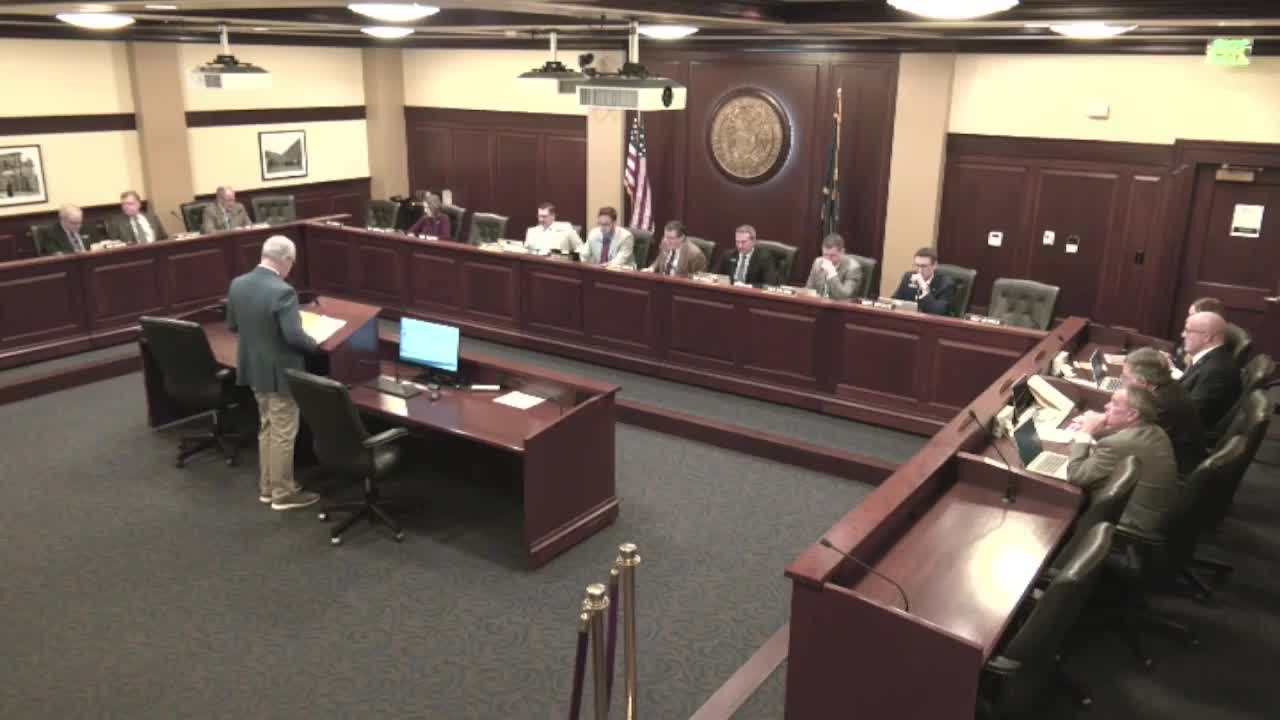
The House Revenue and Taxation Committee on Feb. 20 voted to send House Bill 25 to the full House with a due-pass recommendation. The measure, introduced by Representative Joe Palmer, would increase annual sales-tax-derived contributions used to bond major road projects under the Techum program by staged amounts over three years.
The House Revenue and Taxation Committee on Feb. 20 voted to send House Bill 25 to the full House with a due-pass recommendation. The measure, introduced by Representative Joe Palmer, would increase annual sales-tax-derived contributions used to bond major road projects under the Techum program by staged amounts over three years.
Representative Joe Palmer, R.-Dist. 20 of Meridian, told the committee the Techum program—created in 2017 to use a portion of sales tax revenue for roads and expanded in 2021 to allow bonding for large projects—has funded highway work across the state. "The program has turned out to work very well," Palmer said, and the bill would add $20 million in the first year, $40 million in the second year and $60 million in the third year to the existing roughly $80 million contribution that currently helps service bonds.
The bill also sets a per-locality cap of $45,000,000, Palmer said, which he described as providing predictability for local planning. "That gives locals the opportunity to have a set amount of money that they can move forward with and they'll know and be able to plan their projects accordingly," he said.
Supporters said the funding accelerates projects and helps avoid higher future costs. Dave Butzier of AECOM, testifying on behalf of the American Council of Engineering Companies of Idaho, said engineering and construction firms statewide back the bill. "We are in support of this," Butzier said, noting member firms have worked on highway projects across Idaho.
Several committee members voiced support. Representative Brandon Cheatham said Idaho relies on roads to move goods and people and signaled he would back the bill while urging better support for local governments, noting the bill increases local allocations by about $3 million but freezes the local cap at $45 million for three years. Representative Jon Raybould argued continued investment is necessary to maintain the state economy and highway connections across long distances.
Representative Ilana Birch said she would not support the bill because it increases transfers from the General Fund at a time when lawmakers recently approved income tax cuts that she said reduce the money available for public education. "My concern is the source of the funding coming from the money that's available to fund public education," Birch said, adding that piecemeal tax and funding changes make it harder to see the larger fiscal picture.
Representative Shepherd moved to advance House Bill 25 to the floor with a due-pass recommendation. The committee then took public testimony from Butzier and, after brief discussion, approved the motion by voice vote. Representative Birch stated she would not support the motion; other members who spoke in favor included Shepherd, Raybould and Cheatham. Representative Palmer will serve as floor sponsor of the bill.
The committee also approved its Feb. 19 minutes earlier in the meeting.
Votes at a glance - Approval to send House Bill 25 to the House floor with a due-pass recommendation: motion by Representative Shepherd; voice vote; motion passed. Representative Ilana Birch stated she would not support the motion. No roll-call tally was recorded in the committee minutes.
Why it matters House Bill 25 increases sales-tax-derived bonding capacity for large transportation projects at a time when committee members cited rapid construction-cost inflation (Palmer noted examples such as concrete rising from about $500 per ton to $1,500 per ton) and ongoing needs to preserve and expand road capacity across Idaho. The bill changes the program’s available annual contribution and sets a fixed locality cap for three years, which supporters say improves predictability for planning and delivery of major projects.
What’s next House Bill 25 will be considered by the full House. If amended or passed there, any changes would be reflected in subsequent committee and floor records.