Get Full Government Meeting Transcripts, Videos, & Alerts Forever!
Get email alerts on the Privacy Technology topic
No spam. Unsubscribe anytime.
Senate approves limits on automatic license-plate readers, bars new VDOT installations pending reenactment
Summary
After lengthy debate, the Senate passed a bill imposing stricter rules on how automatic license-plate recognition (ALPR) data may be stored and used, reducing retention from 30 to 21 days and placing a reenactment clause on any expansion onto VDOT right-of-way.
The Senate on Thursday passed legislation that tightens use, retention and vendor requirements for automatic license-plate recognition (ALPR) systems used by government entities.
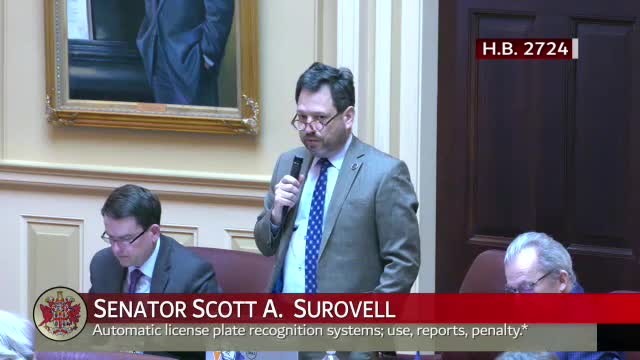
Senator Sarravel, the senator from Eastern Fairfax, explained the version before the chamber included two major changes from earlier drafts: a reenactment clause that pauses any expansion of ALPR installations onto Virginia Department of Transportation (VDOT) right-of-way, and a reduction of the data retention period from 30 days to 21 days. "The big changes are number 1, there's a reenactment clause on any expansion of the program," Sarravel told colleagues, and "secondly, the data retention period was moved back from 30 days to 21 days." He described additional guardrails on vendor usage, prohibitions on indefinite retention and penalties for unauthorized access.
During Q&A senators asked for clarity on when different provisions take effect; Sarravel said many of the bill’s enactments would be effective July 1 if the bill is signed, though some reporting deadlines extend later in the year. The bill retains exceptions for existing local installations on local-right-of-way and private-property cameras already in use.
Supporters said the bill balances law-enforcement needs with privacy protections; critics cautioned about oversight mechanics. The Senate recorded the final passage as 28 aye, 11 no.
What’s next: the bill moves to the House-Senate conference or the House for concurrence, depending on next steps. If enacted, the reenactment clause will block expansion of ALPR on VDOT rights-of-way pending later legislative action, while tightened retention and access rules would apply to existing users.