
Committee considers 3-year property-value freeze to encourage ADU construction and BHIP participation
Get AI-powered insights, summaries, and transcripts
Subscribe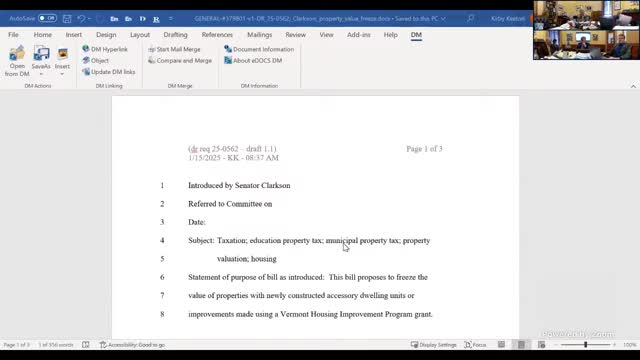
Summary
Legislative counsel and the committee discussed draft language to freeze taxable value increases for three years after certain ADU or BHIP grant-funded improvements, aiming to remove a disincentive to adding accessory dwelling units and to shift some BHIP projects toward ADUs.
Senate committee members reviewed draft language Feb. 21 that would temporarily stabilize property-taxable value increases tied to certain new accessory dwelling units (ADUs) and to qualifying BHIP (home rehab) grant-funded projects.
The proposed provision would "fix and maintain the taxable value at the property's grand list value in the year immediately preceding improvements" for a three-year period after completion in specified cases, committee counsel said. The policy is designed as a limited-value freeze — not a permanent exemption — to give property owners time to earn rental income from an ADU without immediately facing a higher property-tax bill.
"The separate purpose here is for certain new construction improvements is to incentivize those activities," counsel said while describing the draft language. The exemption would apply to municipal and education property taxes and remain in effect for three years; if the property value later falls (for example, due to damage), the taxable value may be reduced accordingly.
Panel members said the incentive is intended to nudge more homeowners to build ADUs — which account for roughly 20% of VHIP/BHIP units to date — and to encourage some owners to choose the grant option that prioritizes housing for people exiting homelessness. Committee members asked staff to obtain a JFO fiscal estimate and to consider timing language (the draft currently requires that the improvement be completed within the prior 12 months when the exemption is claimed; some suggested an 18-month completion window might be preferable).
"That was the intent — to just stabilize it for three years and let them earn some income from it so that they can then be able to afford that bump," a sponsor said. Department staff said they did not see immediate concerns but would consult with colleagues and provide follow-up detail.
Ending
Committee members asked legislative counsel and the Housing Division to refine the draft, get a JFO fiscal estimate and continue the discussion next week. The measure was presented as a targeted, temporary incentive rather than a general tax cut.