Get Full Government Meeting Transcripts, Videos, & Alerts Forever!
Get email alerts on the School Funding Adequacy topic
No spam. Unsubscribe anytime.
Consultant to House finance subcommittee: 'Fully funded' must mean proficiency and opportunity, cites Moore v. Alaska
Summary
Mike Bronson told the House Finance Education Subcommittee that a legally "fully funded" school must provide the opportunity to meet state standards and produce a substantial majority of students proficient. He cited the 2007 Moore v. Alaska decision and recommended a statewide adequacy study to guide funding decisions.
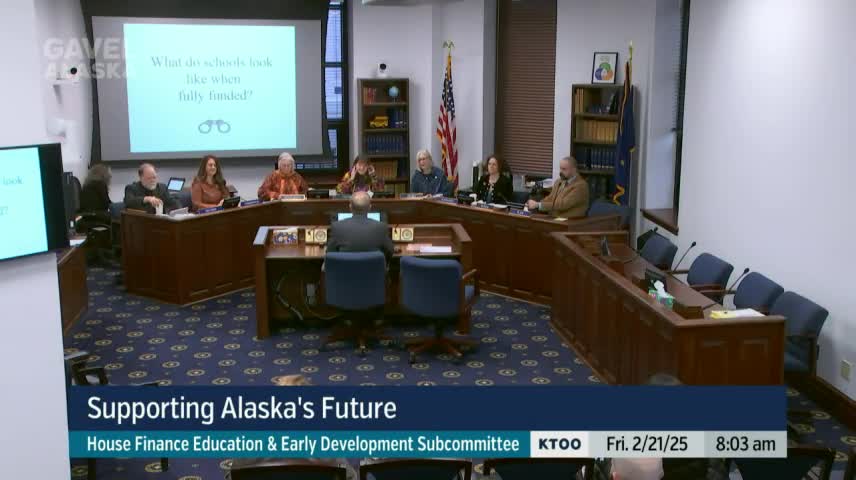
Mike Bronson, an education consultant, told the House Finance Education Subcommittee on Feb. 20 that the phrase “fully funded” needs a clear, legal definition if legislators are to meet the state Constitution’s duty to provide public education. Speaking to the panel chaired by Rep. Galvin, Bronson said the legal and technical answers converge on two measures: student proficiency on state standards and equitable opportunity for a substantial majority of students to reach those standards.
Bronson pointed lawmakers to the 2007 Moore v. Alaska court decision and Judge Gleeson’s subsequent 196‑page opinion as the clearest legal framing of adequacy. He said the judge’s ruling emphasized the state’s responsibility to fund an education that affords every child a meaningful opportunity to learn academic standards and that funding should be sufficient so a substantial majority of students can be proficient on state assessments. Bronson summarized his central point: “I’ll just spill the beans … 1 of the answers to the question what does fully funded mean for schools boils down to 2 things. 1 is proficiency … and the second is … full opportunity.” (Mike Bronson, consultant)
Why it matters: the finance committee allocates the dollars the Legislature controls. Bronson urged members to use concrete, defensible analyses to connect funding decisions to the constitutional standard. He said adequacy is not the same as district budget requests or aspirational descriptions of “good” schools; rather, it is a measurable obligation rooted in law and professional adequacy studies.
Evidence and history. Bronson reviewed Moore v. Alaska and its aftermath. The judge denied the plaintiffs’ request for a broad funding increase in 2007 — finding then‑current test scores supported the state’s funding level — but also set four criteria for constitutional adequacy and required targeted interventions for low‑performing districts. Bronson told the committee the judge approved settlement pilot projects focused on the state’s lowest‑performing schools, including targeted grants, expanded kindergarten in some districts, teacher‑retention grants and graduation supports; those interventions and associated funding ran primarily through about 2012, Bronson said.
Bronson also described how Alaska’s later tightening of academic standards revealed lower proficiency statewide. He summarized recent statewide results as “low and unacceptable,” citing statewide proficiency levels in the 30–40 percent range on current assessments and concluding that a contemporary judge reviewing similar evidence would likely find funding inadequate unless the Legislature acts.
Technical models and next steps. Bronson contrasted the court lens with professional adequacy studies. He highlighted a 2015 district adequacy study for the Anchorage School District that modeled staff mixes and additional teacher categories a successful district used elsewhere in the U.S. as a template for achieving proficiency. Bronson recommended the Legislature commission a similarly rigorous statewide adequacy study to translate proficiency goals into staffing, program, and budget figures that the finance committee could rely on.
Class size versus planning ratios. Bronson warned lawmakers not to conflate pupil‑teacher ratio (PTR) with actual homeroom class size: PTR is a planning number and typically understates the number of students in a classroom. He advised the committee to request homeroom‑size data from districts, especially at K–3, because homeroom sizes give a clearer picture of instructional load and help link dollars to opportunities to learn.
Committee exchange and concerns. Representative Bynum asked Bronson for background on Moore v. Alaska; Bronson summarized the case’s origins, settlement components, and the judge’s 2007 decision. Several members emphasized measuring growth as well as proficiency: Bronson pointed to year‑to‑year growth data (third‑grade growth charts) used in Anchorage as an example of how some schools produced much more learning growth than others. He recommended that any adequacy study incorporate both proficiency targets and measures of student growth and suggested DEED and the Legislature could use such a study to align resources and interventions.
Where the work goes from here. Bronson repeatedly urged the subcommittee to commission a professional adequacy study that would (a) model the staffing and program investments required to provide opportunity to learn statewide and (b) build metrics to track progress. The subcommittee is scheduled to hear from the Department of Education and Early Development on Feb. 26, per the committee’s agenda.
Ending note: Bronson told the panel he was available to consult further and to provide models and data; members thanked him for his presentation and signaled follow‑up questions at future meetings.