Get AI Briefings, Transcripts & Alerts on Local & National Government Meetings — Forever.
House Government Committee advances a slate of bills on safety, records, mental-health courts and housing
Loading...
Summary
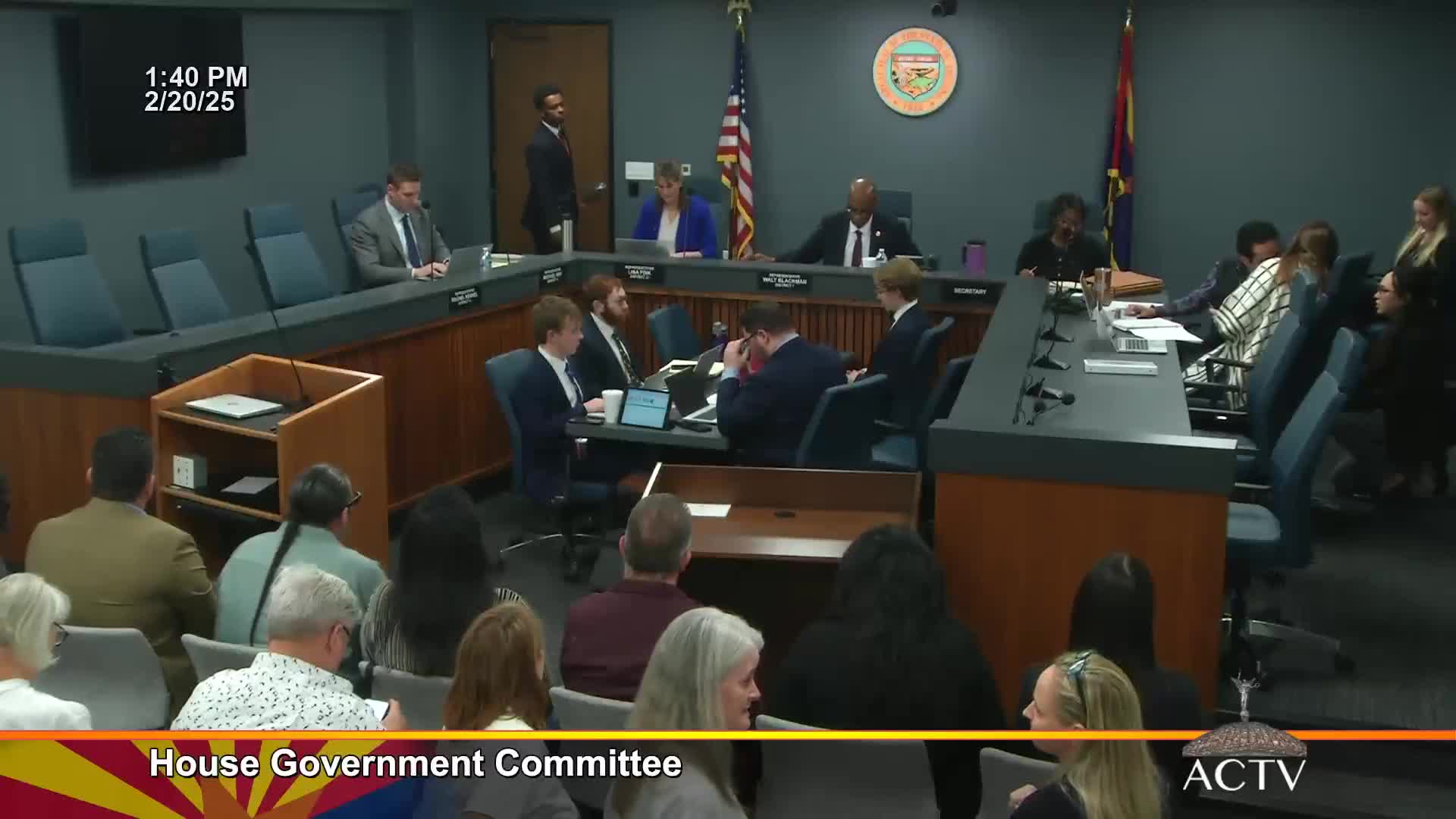
House Government Committee Chair Blackman called a special Feb. 19 meeting to consider a heavy agenda of bills, and members returned a package of measures to the full House with due‑pass recommendations on matters ranging from building safety to public‑records rules and veterans treatment courts.
House Government Committee Chair Blackman called a special Feb. 19 meeting to consider a heavy agenda of bills, and members returned a package of measures to the full House with due‑pass recommendations on matters ranging from building safety to public‑records rules and veterans treatment courts.
The committee spent its roughly half‑day hearing testimony on 15 bills, frequently moving them on voice votes or roll call after short sponsor explanations and stakeholder remarks. Several items drew extended debate — notably a public‑records/open‑meetings bill and a contentious housing/ADU measure — and multiple bills were amended in committee before being returned to the House.
Why it matters: the committee’s actions set legislation that would change local practice and state policy. Successful committee votes advance measures to the House floor where final passage (and in some cases placement on the ballot) would change how local governments inspect building systems, notify parents, publish public records, protect title owners from deed fraud and run veterans treatment courts, among other outcomes.
What the committee did (selected highlights) - Building‑safety inspections (HB2341): The committee gave HB2341 a due‑pass recommendation (7‑0). The bill requires municipalities and counties to inspect smoke and fire dampers according to nationally recognized standards and directs local governments to adopt enforcement rules by Jan. 1, 2026. Supporters said the measure responds to field reports that many dampers fail years after installation and that regular inspection is important in schools and hospitals. The committee record included testimony from Representative Teresa Martinez (bill sponsor), a sheet‑metal workers’ representative, and the state forester/state fire marshal, who said the office is neutral and would rely on certificates of compliance as evidence of inspection.
- Juvenile‑notification and school‑Miranda protections (HB2779, as amended): The committee returned HB2779 as amended with a due‑pass recommendation (7‑0). The amendment softens an absolute timing requirement to a “good faith effort” to notify parents/guardians when a juvenile is taken into temporary custody, requires immediate notification for incidents on school property, and directs the Department of Education to establish a training program for specified school employees. Sponsors framed the bill as a response to individual cases in which parents were not told when a child was taken into custody.
- Court‑ordered intensive treatment for the chronically mentally ill (HB2706): The committee returned HB2706 with a due‑pass recommendation (7‑0). Sponsors said the bill expands court‑ordered treatment options beyond medication — including housing, transportation and residential supports — for a narrowly defined chronically mentally ill population that has not responded to lower levels of care. Proponents said the change would complement other state efforts to improve capacity and oversight.
- Open‑meetings and public‑records changes (HB2927): HB2927 was returned with a due‑pass recommendation after debate and a short amendment (vote recorded 4 ayes, 1 nay, 2 present). The bill would change notice and access rules for public meetings, require receipts or acknowledgements for public‑records requests within a short time frame, and add a civil penalty for willful non‑compliance with public‑records law. County and municipal groups testified in opposition or concern, saying that the five‑day acknowledgement requirement is well‑intentioned but may set unrealistic expectations for small jurisdictions with limited staff; sponsors said the idea is to create communication and predictable timeframes rather than immediate fulfillment.
- Rare disease advisory council (HB2380): The committee returned HB2380 with a due‑pass recommendation (5 ayes, 1 nay, 1 present). Sponsors and rare‑disease advocates said a council would give patients, families and clinicians a formal mechanism to advise the legislature and state agencies. Supporters pointed to the 30‑state trend of establishing similar advisory bodies.
- Recorder waiting period to help prevent deed fraud (HB2831): The committee gave HB2831 a due‑pass recommendation (7‑0). The bill would create a five‑day waiting period before county recorders finalize certain real‑property recordations and notify subscribed title‑alert registrants to allow property owners an opportunity to detect fraud. Sponsors cited recent deed‑fraud cases and existing county title‑alert programs.
- ADUs / accessory‑dwelling rules (HB2928): The committee returned HB2928 with a due‑pass recommendation (5 ayes, 2 nays) after extended testimony from cities, counties and housing advocates. The bill would expand where accessory dwelling units are allowed and clarify application across municipalities and counties; opponents from rural counties and several cities asked for more local‑control and infrastructure safeguards (wells, septic, wildfire risk) and urged additional guardrails or exceptions.
- Veterans treatment court program framework (HB2843, as amended): The committee returned HB2843 as amended with a due‑pass recommendation (voice/roll call). Sponsors and many veteran advocates testified in support; testimony included veterans and family members who described the courts’ role in reducing recidivism and coordinating clinical and VA services for justice‑involved veterans.
Votes at a glance (committee actions reported from the Feb. 19 hearing) - HB2341 (fire/smoke damper inspections): due pass recommendation, tally 7 ayes, 0 nays (approved by committee) - HB2779 (juvenile notification; school procedures; amendment adopted): due pass recommendation, tally 7 ayes, 0 nays - HB2706 (court‑ordered intensive treatment plan/SMI): due pass recommendation, tally 7 ayes, 0 nays - HB2927 (open meetings / public records changes): due pass recommendation, recorded 4 ayes, 1 nay, 2 present - HB2380 (Arizona Rare Disease Advisory Council): due pass recommendation, 5 ayes, 1 nay, 1 present - HB2831 (5‑day title/recorder waiting period to address deed fraud): due pass recommendation, 7 ayes, 0 nays - HB2789 (temporary personnel hoists/elevators for construction safety): due pass recommendation, 4 ayes, 3 nays - HB2868 (proposed restrictions on preferential treatment in public institutions — constitutional/ statutory alignment): due pass recommendation, recorded 4 ayes, 3 nays - HB2763 (contract language cleanup for federal agreements): due pass recommendation, 5 ayes, 2 nays - HB2928 (ADU expansion / county and municipal rules): due pass recommendation, 5 ayes, 2 nays - HB2895 (task‑order contract posting / procurement transparency): due pass recommendation, recorded 4 ayes, 2 nays, 1 present - HB2442 (condominium / HOA budget, reserves and member ratification process; amendment adopted): due pass recommendation, recorded 4 ayes, 3 nays - HB2824 (legislative subpoena / contempt procedure alternatives): due pass recommendation, recorded 4 ayes, 3 nays - HCR2057 (change initiative petition thresholds): due pass recommendation, recorded 4 ayes, 3 nays - HCR2025 (require 60% approval for constitutional amendments placed on the ballot): due pass recommendation, recorded 4 ayes, 3 nays
Discussion and next steps Committee members and stakeholders asked for follow‑up work on several items. Counties and smaller jurisdictions pushed back on strict public‑records timeframes and asked for larger exceptions or implementation windows; the majority sponsor said he was willing to continue negotiations. Several bills that passed the committee were amended in committee and will carry sponsor‑amendments to the House floor. For more contentious measures — notably ADUs and HOA reform — multiple members urged post‑committee stakeholder meetings to refine language and add implementation guardrails before floor debate.
What to watch next - Whether the House majority adopts the committee amendments on public‑records timing and the ADU language after additional stakeholder conversations. - The House floor calendar for these bills: due‑pass recommendation sends them to the full House for second‑committee or third‑reading consideration; any bill approved by the House will move to the Senate or, for the concurrent resolutions, to the ballot process if passed by both chambers.
Sources and attribution This article is based on the Feb. 19, 2025 House Government Committee transcript and on on‑the‑record testimony and roll calls recorded during the committee session. Quotes and details are attributed to sponsors and witnesses who spoke in committee and are listed in the speakers array below.