Get Full Government Meeting Transcripts, Videos, & Alerts Forever!
Get email alerts on the Riverside Feasibility topic
No spam. Unsubscribe anytime.
Board approves Riverside School feasibility specs after debate over two preschool classrooms
Summary
After a long public and board discussion about preschool capacity, fire-code limits and costs, the Greenwich Board of Education approved Riverside School ed specs on Feb. 26 but removed two proposed pre‑K classrooms; board members asked the administration for further analysis of preschool alternatives and costs.
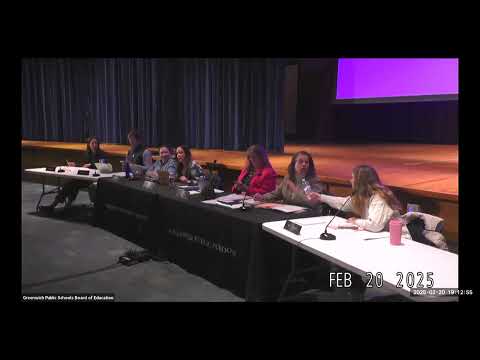
The Greenwich Board of Education voted Feb. 26 to approve feasibility specifications for a proposed Riverside School renovation but removed two proposed preschool classrooms after a lengthy discussion about preschool demand, building constraints and cost.
Board member Sophie moved to approve the Riverside ed specs; after discussion the board amended the motion to approve the specs "as presented, except remove the two pre‑K classrooms," and the amended motion carried. The board asked the administration and architect to supply a revised specification and updated cost estimates with the pre‑K exclusion.
The debate centered on whether the new classrooms were the best way to add preschool capacity. PCG and district staff said preschool enrollment for children with special needs has climbed sharply over recent years and that federal law requires preschool special-education placements to include typically developing peers. Superintendent Dr. Jones and staff explained preschool classrooms must be on or near the ground floor to comply with fire egress and building code requirements, which limits the number of candidate rooms in many Greenwich elementary buildings.
Board members also discussed alternatives: adding preschool sections at other schools (Julian Curtis already has two preschool classrooms in an existing ed spec), renting interim space, or building a centralized early-childhood center. Cost figures were a point of dispute during debate: one board member cited a roughly $2.5 million figure for adding the two preschool classrooms and about $200,000 for associated playground work; the district's architect said estimating a standalone line item is not simple at this stage because conceptual costs are derived from overall building-trade estimates and square-foot pricing.
Supporters of the pre‑K classrooms argued the district is short a classroom this year and that Riverside is a school with a history of enrollment growth. Opponents raised the need for a fuller district plan and cost comparisons for alternatives, and some board members said the preschool discussion should be part of a broader, district-level strategy on pre‑K capacity and state-directed changes to early-childhood policy.
Board Chair thanked the feasibility committee and the community for input. The board directed staff to return a revised ed spec without the two preschool classrooms and asked for a later, separate analysis of preschool capacity options, transportation impacts and 10- to 20-year cost comparisons.
Ending: The board approved the Riverside ed specs as amended; the administration will provide an updated specification and cost estimate and present options on preschool capacity at a future meeting.