Get Full Government Meeting Transcripts, Videos, & Alerts Forever!
Get email alerts on the School Budget topic
No spam. Unsubscribe anytime.
Franklin Township board adopts $194.7 million 2024-25 school budget, approves withdrawals from reserves
Summary
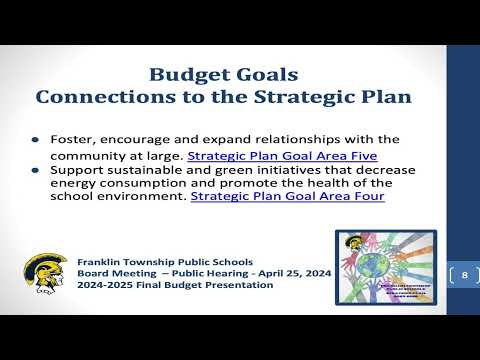
After a public hearing and presentations from district leaders, the Franklin Township Board of Education approved the 2024–25 operating budget that relies on a 2% tax levy increase plus an allowable healthcare adjustment and draws on capital and maintenance reserves.
The Franklin Township Board of Education voted to adopt the district’s final fiscal year 2024–25 budget following a public hearing and presentations by district leaders.
The budget approved April 25 totals about $194.7 million in general fund revenues, according to School Business Administrator Stephen Fried, who told the board the proposed levy — a 2% increase plus an allowable health-care adjustment — represents about 84% of general fund revenues. “That amount represents 84% of the general fund revenues for the entire district,” Fried said.
The budget matters because it sets spending for instruction, special education, transportation and employee benefits in a district that relies heavily on local property taxes. Superintendent (presenter) Dr. Valli said the budget maintains and expands several programs the board prioritized, including an addition of 85 prekindergarten seats funded by a state grant, expansion of bilingual services and continued investment in special education supports.
Fried and Dr. Valli (presenter) walked the board and the public through revenue sources and major cost drivers. Fried reported a 4% overall increase in general fund revenues driven largely by the tax levy and described a drop of roughly $386,000 in some state aid lines. On expenditures, he highlighted a 20% rise in student transportation costs and an 8% jump in employee benefits driven primarily by health-care increases. “Student transportation ... is up $3,400,000. That’s a 20% increase,” Fried said. The district plans to use $2.5 million from capital reserve and $1.0 million from maintenance reserve for identified projects.
Board members asked for clarification during the discussion. Member Bill asked whether the district’s new on-site health center will lower health-care costs; Dr. Valli (presenter) said the center is intended to slow the rate of increase and that self-insurance has already helped the district control premiums. Board members also pressed staff on transportation and charter tuition assumptions; Fried said the district used trend analysis to lower the state-proposed 12% charter tuition increase to a 6% projection based on local enrollment trends and county office review.
Public comment on the budget included praise for the bilingual program expansion and interest in solar-panel revenues and electric buses. Deputy Mayor Ed Potasnick commended the bilingual expansion and urged the district to pursue electrifying buses where possible.
After the hearing and a brief public comment period limited to the budget, the board moved to adopt the final budget and approved a motion to adopt sections 1 through 7 (with section 7 described as a maintenance-reserve withdrawal). The motion was moved by Mister Grippo and seconded by Jimmy; the roll call recorded six affirmative votes (Mister Grippo; Doctor Hopkins; Mister Jackson; Mister Parker; Mister Chaban; Miss Singh). The motion carried.
The board president thanked staff and finance committee members for the work on the budget; Dr. Valli (presenter) and Fried said the district will upload the operational budget and begin summer purchasing for the 2024–25 year. The district’s fiscal year begins July 1.
The board also approved a large consent package later in the meeting covering minutes, policies, personnel, contracts and capital work (see “Votes at a glance”).
With the budget adopted, district leaders said they will proceed with planned program expansions and capital work and continue monitoring state aid and charter tuition adjustments as actual enrollment and state allocations are finalized.