
Tar-Pamlico Basin association briefed commissioners on proposed state nutrient rule changes
Get AI-powered insights, summaries, and transcripts
Subscribe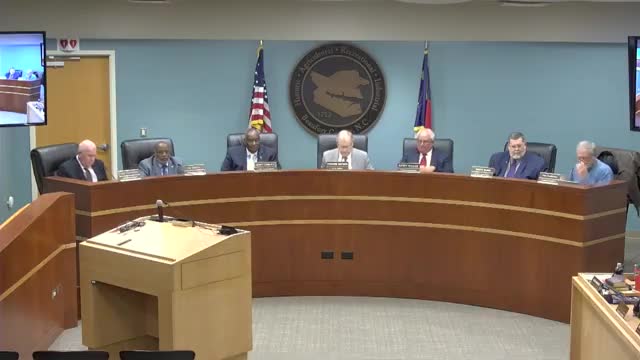
Summary
Adam Waters of the Tar Pamlico Basin Association summarized the history of a 1990 memorandum of agreement for nutrient trading, explained state DEQ’s effort to move MOA language into rule and told commissioners about the comment period and public hearing schedule.
Adam Waters, executive director of the Tar Pamlico Basin Association, briefed the Beaufort County Board of Commissioners on proposed state rule revisions that would incorporate an existing memorandum of agreement (MOA) governing nutrient caps and trading among municipal wastewater systems in the Tar‑Pamlico River basin.
Waters described the association as a nonprofit consortium of 15 municipal wastewater permittees that negotiated a collective nutrient-trading MOA in 1990 to limit nitrogen and phosphorus discharges and to allocate a collective annual cap among members. The MOA was renewed several times (1995, 2002/2005, 2015); DEQ informed the association that, because the MOA’s terms met the definition of a rule and lacked enforceability without being a rule, the state proposed rewriting that MOA language into 15A NCAC 02B .0733 (a state water quality rule).
Waters said the proposed rule changes were negotiated with DEQ and taken through the state water quality committee and the Environmental Management Commission; the rule entered a 60‑day comment period on Jan. 1 and remains open through March, with a public hearing scheduled Feb. 6 at 6 p.m. at the Pitt County Agricultural Center. Waters also explained the association’s nutrient-trading history, dues structure (dues based on permitted flow, not performance) and said larger industrial point sources such as Nutrien are handled under separate permits and are not part of the association’s proposed rule changes.
Commissioners asked whether plants that outperform others are paid for surplus performance; Waters said members share credits and the association assesses dues based on permitted flow. Commissioners also asked whether the river is cleaner than 30 years ago; Waters declined to offer a scientific judgement and offered anecdotally that local fishing has improved.
Waters encouraged interested residents to submit comments during the public comment period and noted the state-level process is the next step for the association’s protections to become enforceable.