Get Full Government Meeting Transcripts, Videos, & Alerts Forever!
Get email alerts on the Opioid Abatement Funding topic
No spam. Unsubscribe anytime.
Charlottesville details opioid-abatement funds, naloxone distribution and treatment pilots
Summary
Deputy City Manager Ashley Reynolds Marshall told council members that the city will receive opioid settlement funds over time and has already spent $45,073 on naloxone vending machines; the city and regional partners have approved or applied for several treatment, crisis center and distribution projects.
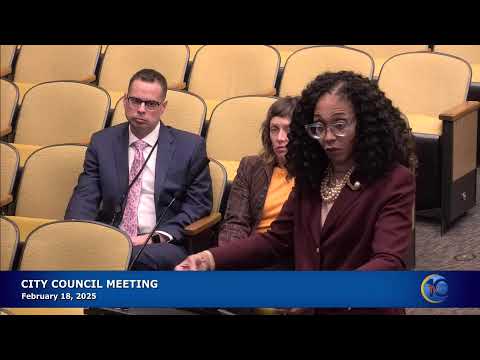
Ashley Reynolds Marshall, deputy city manager for the city of Charlottesville, briefed the Charlottesville City Council at a work session on the city’s opioid abatement funding streams, recent expenditures and proposed pilot programs.
Marshall said the opioid settlements and related state authority produce three primary funding streams for the city: direct distributions from distributors, an individual (noncompetitive) distribution for cities/counties that requires annual application, and a “gold standard” pool that requires a pledge to use funds on evidence-based opioid remediation and treatment. She summarized allowable uses: “You can spend money to treat opioid use disorder, which you also will see in documents as just OUD. You can spend money to prevent opioid use disorder, and you can spend money to abate or remediate opioid use disorder.”
The nut graf: city officials heard that the city already approved one expenditure — a $45,073 distribution to the Charlottesville Fire Department for naloxone vending machines — and that multiple cooperative grants and pilot programs are either approved or under review, including crisis assessment center expansion, community outreach, a jail-based SUBLOCADE pilot, an embedded mental-health clinician for the regional emergency communications center, and a citywide naloxone-access effort.
Marshall provided state- and local-level context. She cited state data saying that in 2023 there were 2,796 drug-overdose deaths in Virginia and that fentanyl was involved in about 79 percent of those deaths. She also cited a state calculation presented to the council that estimated opioid-crisis costs in Virginia at roughly $5 billion and a city per-capita cost “over $600.” Local emergency response data showed average monthly overdose incidents of about 6.6 (rounded to seven) in 2022, an average of about eight in 2023 with monthly spikes, and a drop to an average of about six in 2024; Marshall said the city’s data are not deduplicated and may count repeat incidents for the same person.
Approved and expended actions: Marshall said council approved in February 2024 a distribution to the Charlottesville Fire Department to support naloxone vending machines; city records show $45,073 has been spent on that initiative. Cooperative grants that were reported as approved or awarded include a regional expansion of a crisis triage/assessment center (CTAC) and expanded Blue Ridge Center community outreach; Marshall said those projects were funded through the state opioid-abatement authority (OAA) cooperative bucket and did not require city direct distributions.
Pending applications and pilots: Marshall said the city has submitted or is reviewing several projects: a multi-jurisdictional pilot to provide SUBLOCADE (a 30-day injectable buprenorphine formulation) in the regional jail to stabilize justice-involved individuals on release; a pilot to embed a mental-health clinician in the regional emergency communications center to divert nonviolent mental-health calls from law enforcement and some emergency-room visits (modeled on Durham’s HEARTS program); and a citywide Narcan (naloxone) access program to add naloxone doses to AED/bloodborne-pathogen boxes and to make doses available at city-facing sites with accompanying Revive training.
Marshall said the city is also working with Region Ten, UVA and surrounding counties on harm-reduction vending machines and a possible treatment navigator pilot to help people complete intake, paperwork and placement for recovery services. She noted the opioid funds cannot be used to supplant existing programs and must be used on evidence-based or evidence-informed interventions. She also said some state and federal funding streams that support partner programs could be at risk, which would affect the local service network even if opioid settlement dollars continue to flow.
Council discussion briefly touched on program details, the legal structure of distributions and safeguards in OAA rules about allowable uses. Council members asked for Revive/Narcan training; Marshall said staff will schedule sessions for council members.
Ending: Marshall asked the council for continued engagement as the city submits annual applications for individual and gold-standard funds and evaluates pilots; she said staff will return with more specific project proposals and reporting as funds are awarded and expended.