Get Full Government Meeting Transcripts, Videos, & Alerts Forever!
Get email alerts on the Land Use topic
No spam. Unsubscribe anytime.
Council opens public hearing, then agrees to move temporary aerial‑easement ordinance for The Verve PUD to next consent agenda
Summary
Council held a public hearing on a proposed up‑to‑five‑year temporary aerial easement to allow three construction cranes for The Verve PUD at 49 Stadium Road; the project manager said cranes will not swing loaded materials over public right‑of‑way and council voted to place the ordinance on the next meeting’s consent agenda.
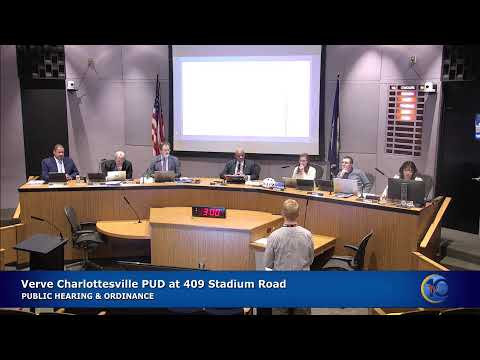
The Charlottesville City Council held a public hearing on a proposed temporary aerial easement for The Verve, a planned unit development at 49 Stadium Road, and agreed to move the ordinance to the next meeting’s consent agenda for action.
Planning staff explained the easement would permit up to five years of temporary aerial access for three cranes needed to construct a 12‑story building. The staff presentation noted the cranes’ reach and showed a plat indicating where the cranes may swing over city right‑of‑way.
Members of the public asked whether crane operations would close roads or swing heavy loads over public streets. Hunter Klein, project manager for John Moriarty & Associates, said the team plans to stage most truck loading on a closed connection between Stadium and Emmett and that “loads will be swung over our property … we just easily trolley the load in to ensure we are not swinging any loads over the public right of way.”
Planning staff and councilors said similar temporary aerial easements have been approved for prior downtown construction and that the proposed arrangement appeared standard. A councilor asked whether safety concerns existed; staff said there were none unique to this application.
After public comment, a councilor moved to place the ordinance on the next meeting’s consent agenda; the motion was seconded and supported. Council did not adopt the ordinance at the meeting; the item will appear for formal consent‑agenda action at the next council meeting.