Get AI Briefings, Transcripts & Alerts on Local & National Government Meetings — Forever.
Florida agencies report progress on cloud migration as lawmakers press for cost, inventory details
Loading...
Summary
A House subcommittee heard agency CIOs and the Northwest Regional Data Center describe multi-year cloud modernization work funded by the Legislature, while members pressed for clearer inventories, cost analyses and data-transfer and disaster-recovery plans.
Members of the Florida House Information Technology Budget and Policy Subcommittee heard an interagency panel Tuesday on the state's multi-year effort to move agency applications and data to cloud platforms, with officials reporting progress on several projects but acknowledging gaps in a statewide inventory and in agency-level cost analyses.
The discussion matters because the cloud migration affects mission-critical systems across state government — from public health records and child-protection case management to corrections and transportation financial systems — and because legislative funding decisions will shape whether agencies can modernize, maintain security, and limit costs. Lawmakers repeatedly asked for clearer cost comparisons, data-transfer estimates, service-level commitments and a complete application inventory.
Warren Sponholtz, State Chief Information Officer for Florida Digital Service, told the committee the cloud offers scalability and moves spending from capital to operating models: "the cloud is in simplest terms, servers and computers that run in a different location," he said, and can reduce some costs while increasing flexibility. Tim Brown, assistant vice president of the Northwest Regional Data Center (NW RDC), summarized the data center's cloud readiness assessment: 24 agencies submitted information on roughly 890 applications, and NW RDC recommended a two-phase migration strategy that initially targets lower-risk transitions to build experience.
Department of Corrections CIO Ken Kisha described a 3-year cloud modernization program for the agency's legacy applications, saying the effort will modernize about 98 legacy applications (86 for the Department of Corrections and 12 for the Florida Commission on Offender Review), and is integrated with the OBIS (offender-based information system) modernization. Kisha said 5 applications have been delivered so far, 7 are planned for custom builds, 17 are slated for commercial off-the-shelf replacement, 15 will migrate as part of OBIS, and 19 have been identified for decommissioning. He told members the program has been allocated about $83,600,000 and described the migration as ongoing.
Jeremy Daniel, CIO for the Department of Elder Affairs, said DOEA began work on a Power Platform modernization in 2024 and completed proof-of-concept work for three applications. He provided line-item figures for current and expected expenditures (contractors: about $350,000 to date; training: about $19,000; licensing/maintenance: about $1.3 million; total to date about $1.7 million) and said additional contractor, licensing and development costs are planned for the next 12 months.
The Department of Health received multiyear funding of $18,850,000, Deputy Secretary Antonio Dawkins said. Health projects include a statewide health-management system being reworked to unify records across 67 county health departments (scheduled for final migration after pilots in 2025–2026) and a rearchitecture of the Child Protection Team information system. FDOT executive director of transportation technology Trey Tillander described a long-running modernization program (since 2019) across hundreds of applications and said FDOT has about $15 million appropriated for 10 cloud modernization projects; he also reported his agency's Azure tenant is incurring roughly $110,000 per month in cloud costs.
Tim Brown emphasized choices and tradeoffs in the assessment: agencies identified transition strategies such as rehosting, replatforming and rearchitecting; NW RDC found 34% of submitted applications will require rearchitecting and 21% rehosting, and that 46% of applications scored in the combined medium‑to‑high transition-effort category while 43% were in the riskiest categories. Brown also said the cloud readiness study focused on applications housed at the Southwood location of NW RDC and should not be taken as an inventory of every state application.
Lawmakers repeatedly pressed officials on two recurring issues: (1) a statewide, authoritative inventory of applications and (2) clear, comparable total-cost-of-ownership figures that include cloud licensing, ongoing operations, and data egress/ingress charges. Brown and Sponholtz said FLDS is building a data catalog focused on data elements, while NW RDC's work focused on application-level rationalization; both efforts overlap but are distinct. Brown said NW RDC and agencies are taking steps to consolidate cloud tenants to negotiate better pricing and that NW RDC acts as a cloud broker for some agencies while other agencies manage their own cloud tenants.
Committee members also raised operational and security concerns: who maintains backups and disaster recovery, whether agencies are using centralized authentication or single sign-on, whether agencies account for latency and data-transfer costs, and how SLAs are defined. Brown said NW RDC provides planned-downtime notifications two weeks to one day in advance and hourly updates during outages; he said standard availability expectations discussed with agencies target 99.9% and that SLAs are application-specific. Sponholtz said agencies remain primarily responsible for their databases but FLDS is working to improve interoperability and enterprise architecture.
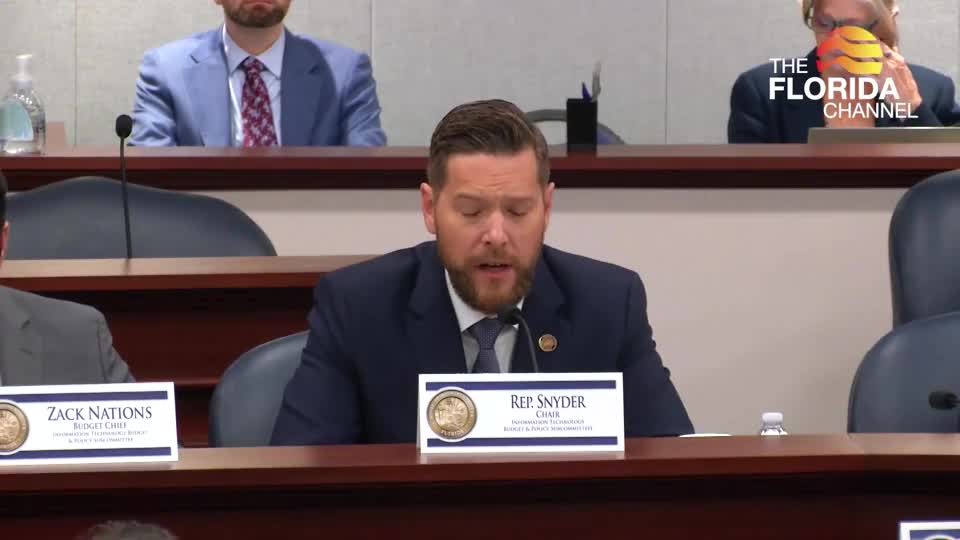
The subcommittee requested additional, agency-level details: up-to-date application inventories, per-application cost analyses (including projected recurring cloud costs and expected savings or efficiencies), and clarifications of which tenants are managed by agencies versus NW RDC. Chair Snyder said the committee will continue to work with agencies to build an enterprise approach. The panelists were dismissed after roughly two hours of presentations and questioning.
Looking ahead, lawmakers signaled they will ask for more detailed documentation — including the NW RDC report the committee had just received — before authorizing further large appropriations or making enterprise-wide architectural decisions. The panel provided an overview of the state approach and progress, but several members said more standardized metrics and centralized visibility are still needed.