Get Full Government Meeting Transcripts, Videos, & Alerts Forever!
Get email alerts on the Environment Noise topic
No spam. Unsubscribe anytime.
Alexandria council backs staff study and phased ban on gas-powered leaf blowers, asks staff to return with ordinance and cost plan
Summary
After a multi-hour discussion, Alexandria City Council gave staff general direction to draft an ordinance to phase out gas-powered leaf blowers, seek community outreach and support for small businesses, and return in spring with specific ordinance language and budget impacts.
City Council on Jan. 28 directed staff to pursue drafting an ordinance to phase out gas-powered leaf blowers in Alexandria, following a detailed presentation on noise, air-quality and enforcement issues.
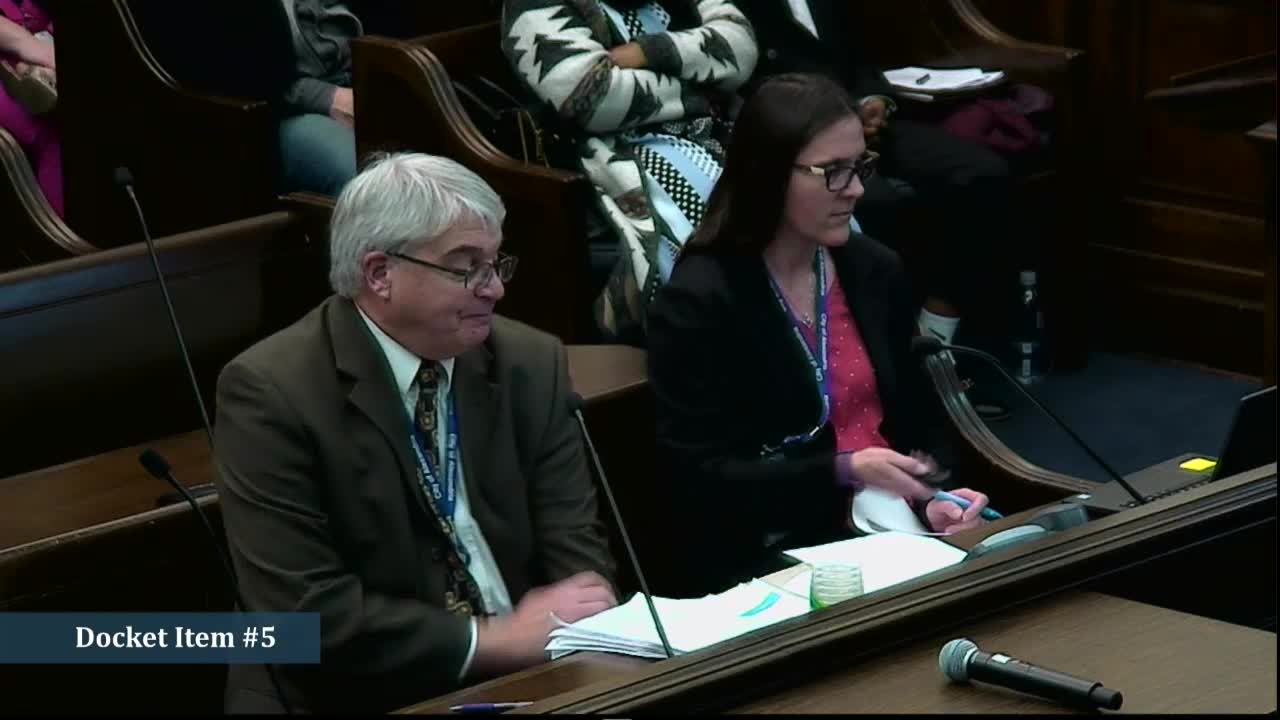
The proposal presented by Bill Scribe, deputy director in the Department of Transportation and Environmental Services, recommended banning gas-powered leaf blowers (but not other lawn equipment), using a multiyear phase-out, and staging targeted outreach for homeowners and commercial landscape operators. "If you desire to more regulate, gas powered leaf blowers, staff's recommendation is ... to actually ban the use of gas powered leaf blowers," Scribe said during the presentation (s:6143.4453–s:6176.77). He added that the city had received a legal opinion from the Virginia attorney general confirming the city’s charter authority to impose such a ban (s:6060.91–s:6096.86).
Why it matters: Gas-powered blowers are the most frequent complaint to the city's noise program, produce higher decibel levels than most other lawn equipment, and emit pollutants associated with two‑stroke engines. Councilmembers framed the measure as a public‑health, equity and small‑business issue: operators breathe emissions directly and many landscaping firms are small, local businesses that would face equipment costs to transition.
What council directed and discussed: Council did not adopt an ordinance that night. Instead members gave staff direction to refine a proposal with these elements: 1) draft ordinance language banning gas‑powered leaf blowers and creating a multi‑year phase‑out schedule; 2) design a targeted outreach plan that includes at least two hybrid meetings (one for the general public and a second focused on commercial landscape businesses); 3) analyze budget impacts and options for city support such as rebates or a small‑business transition grant; and 4) accelerate the city fleet transition to battery powered equipment. Council asked staff to return in the spring for formal consideration. Mayor Aaliyah Gaskins and Vice Mayor Amy Bagley both voiced support for further action; Bagley said she was "supportive of this measure" while urging robust outreach and small‑business assistance (s:7554.135–s:7563.914).
Key details and clarifying figures from staff: The current noise code regulates hours (Monday–Friday 7 a.m.–9 p.m.; weekends 9 a.m.–9 p.m.) but no decibel standard (s:5967.4946–s:6028.045). Staff said battery blowers are typically 5–10 decibels quieter than gas models and that technology for homeowner devices has improved rapidly (s:7499.9297–s:7508.485). Staff gave preliminary cost ranges for city replacement of its own equipment (roughly $60,000–$70,000) and for contracted services (an estimated $40,000–$45,000 annually), and noted commercial landscapers may require multiple batteries and higher up‑front costs (s:6748.9497–s:6774). Council members pointed to examples: Washington, D.C. phased in over about three years; Montgomery County used roughly a two‑year timeline (s:6992.64–s:7002.555).
Outstanding questions and next steps: Council asked staff to return with ordinance language, enforcement options and the likely compliance model (education first, then warnings and fines as in the current noise enforcement regime). Staff noted the existing code’s penalty pattern (first violation $100, second within two weeks increases) but said enforcement approach will be refined (s:7366.955–s:7400.505; s:7481.245–s:7498.51). Council also requested analysis of any additional staffing needed for compliance; the city manager asked that the staffing and cost impacts be included in the next budget memo.
Council members repeatedly emphasized equity and small‑business impacts and urged that outreach materials be language‑accessible and that staff explore incentives or rebates for minority‑owned and small landscaping firms. Vice Mayor Bagley recommended leveraging boards and commissions (e.g., Beautification Commission) for education and demonstration events (s:7619.9854–s:7657.13).
What staff will return with: ordinance draft, outreach plan (including targeted business meeting), estimated city equipment replacement costs and budgetary impact for accelerated city fleet changeover, options for small‑business support, and a recommendation for a phase‑out timeline for council consideration in the spring.