Get Full Government Meeting Transcripts, Videos, & Alerts Forever!
Get email alerts on the Pharmacy Benefit Managers topic
No spam. Unsubscribe anytime.
Insurance department says it will publish penalty structure after PBM enforcement raised questions
Summary
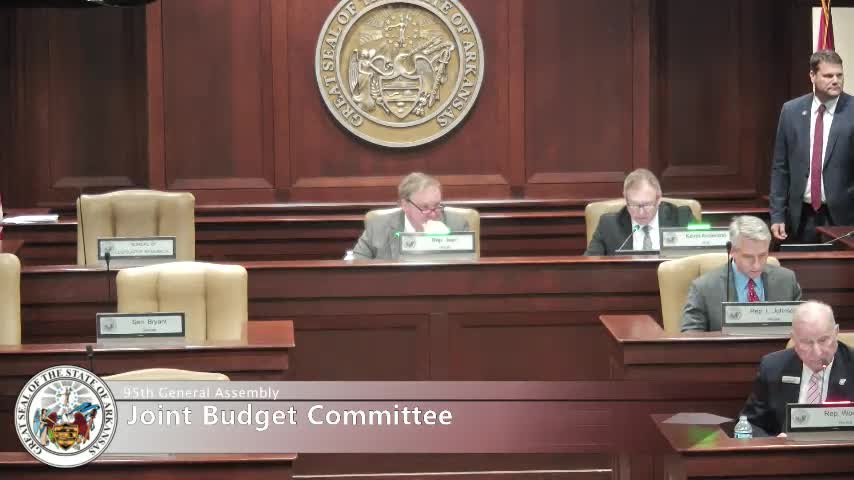
State insurance staff told the Joint Budget Committee they are writing a bulletin to clarify penalties under emergency Rule 128 for pharmacy benefit manager (PBM) violations after initial July enforcements drew criticism for large flat fines applied to very small pricing deviations.
The Arkansas Insurance Department told the Joint Budget Committee during its meeting that it will publish a penalty structure to govern enforcement under emergency Rule 128 for pharmacy benefit manager behavior after the department’s first set of July enforcements prompted questions about large fines for small pricing deviations.
The clarification follows committee questioning about fines that began at the statutory maximum. Daniel Hall, general counsel for the PBM Division at the Arkansas Insurance Department, told the committee, "We have the authority to assess a penalty up to $5,000." Hall and other department staff said the department will issue a bulletin establishing a graduated penalty schedule so penalties start lower for initial violations and increase for repeat infractions.
The issue arose after pharmacy owners and several legislators raised examples in which reimbursements were measured as fractions of a cent or a few dimes below the pricing benchmark used by the department. "A lot of the infractions were less than 30¢. Some of them even were less than a fraction of a cent," said Booth Ran, general counsel (transcript), describing the kinds of deviations that prompted negotiations with PBMs. Committee members said that assessing the same maximum civil penalty for both small and large deviations risked appearing unreasonable and could undermine deterrence and credibility.
Representative Wooten, pressing for tougher enforcement, said the state must send a firm signal: "We need to slam the door on the first thing and get their attention because they are hurting our pharmacists in the state as well as the taxpayers." Other lawmakers urged the department to balance proportionality and deterrence — several senators suggested an escalating schedule tied to both the amount below the benchmark and the frequency of violations.
Department staff explained the practical challenge: the federal pricing benchmark (NADAC) changes weekly, and a prescription fill can fall on different weekly snapshots. Amy Seal, director of the PBM department at the Arkansas Insurance Department, and Daniel Hall said the bulletin will address timing and volume considerations so assessments more fairly reflect pricing fluctuations and operational realities.
Committee members also discussed possible restitution and the disposition of civil penalties. Committee members were told that fines assessed by the department currently go to state general revenue, and that using fine receipts to reimburse harmed pharmacies would require special legislation or an appropriation change. Department staff said the Arkansas insurance code contains authority for the commissioner to order restitution to economically harmed parties, though the department does not routinely exercise that option.
The insurance department's report (item B‑1) was filed with the committee; staff were excused after the presentation. In discussion the department repeatedly described a near-term plan to issue a bulletin that (1) establishes tiered fines tied to amount and frequency of NADAC deviations and (2) clarifies how weekly NADAC snapshots will be evaluated for individual claims so as to reduce the risk of "gotcha" complaints based on timing.
The committee’s discussion included concerns about the operational costs for pharmacies, which committee members said can be $10–$12 in staff time and administrative work to fill a prescription even when reimbursement deviates by only a few cents. Staff said Rule 128 also contains provisions to address pharmacy administrative reimbursement separate from fines for violations.
The department’s staff indicated they expect to publish the bulletin and follow a staged enforcement approach going forward, but they did not provide an exact date for publication at the meeting.