Get Full Government Meeting Transcripts, Videos, & Alerts Forever!
Get email alerts on the Drinking Water Pfas topic
No spam. Unsubscribe anytime.
Merrimack Village District sees seasonal PFOA spikes; escrow for Saint‑Gobain treatment exhausted
Summary
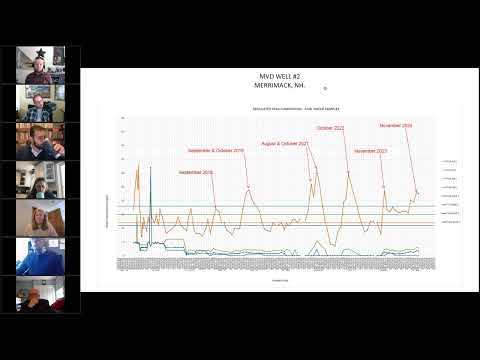
Don Provencher, chair of the Merrimack Village District water department, told the Legislative Study Commission on Feb. 14 that the district’s routine PFAS sampling shows recurring seasonal spikes in PFOA and an upward trend in wells nearest the former Saint‑Gobain facility.
Don Provencher, chair of the Merrimack Village District water department, told the Legislative Study Commission on Feb. 14 that the district’s routine PFAS sampling shows recurring seasonal spikes in PFOA and an upward trend in wells nearest the former Saint‑Gobain facility.
“PFOA is really the only thing that is in violation of any groundwater standards in New Hampshire,” Provencher said, and he described repeated late‑summer into fall peaks across multiple production wells. He told commissioners that wells 4 and 5 — the two closest to the Saint‑Gobain site — have shown an upward trend since about 2023.
The pattern described by Provencher shows spikes at wells across Merrimack and nearby Hollis, often in late summer and into the fall. Provencher said one hypothesis is reduced groundwater recharge during drier periods can concentrate PFAS in the aquifer; he also noted uncertainty in early laboratory data and that some wells (well 3) were taken out of service because of high sodium and chloride.
Why it matters: recurring and, in some wells, rising PFOA concentrations affect the district’s treatment operations and operating costs. Merrimack Village District (MVD) uses granular activated carbon (GAC) for point‑of‑entry or point‑of‑treatment systems on impacted wells and monitors distribution system samples quarterly.
How MVD is operating its treatment: Provencher described a lead/lag vessel strategy. When the district replaces media in one vessel the previously replaced vessel becomes the lead vessel; the district monitors that lead vessel and replaces media after breakthrough but “no sooner than eight months.” Provencher said that approach balances budgetary limits against the district’s goal of achieving non‑detect levels in distribution water most of the time. He said distribution system sampling is nondetect about 90–95% of the time.
Funding and near‑term costs: Provencher said MVD entered a 2018 settlement with Saint‑Gobain under which the company built the treatment plant for wells 4 and 5 and provided an operations and maintenance (O&M) escrow to cover roughly five years of filter O&M. Provencher said the escrow summed to about $534,000 and was intended to cover approximately $107,000 per year; he told commissioners the escrow was exhausted in October 2024 and “the escrow lasted four years. It didn't quite get into the fifth year.”
Provencher said the district has budgeted O&M costs into the next fiscal year and does not currently plan a rate increase beyond a roughly 4% budget increase, but he cautioned continuing elevated concentrations could shorten media life and raise costs.
Supply and interconnects: Provencher described a wholesale interconnect that allows the district to buy treated water from a neighboring system. He said the interconnect permit allows up to 250,000 gallons per day on average and 500,000 gallons per day at peak; MVD has limited use of that supply to summer periods because low levels of PFAS have been detected in that source.
Other capital needs: Provencher said MVD expects to replace most customer meters over the next five years at an estimated total cost of about $2.3 million. He said meter replacements will also support a lead/copper inventory effort by allowing crews to inspect service connections during the work.
Community concerns and technical questions: Commissioners and technical panelists asked about soil sampling, aquifer dynamics and whether seasonal pumping or site activities (demolition, blasting) could mobilize PFAS. Several technical participants — including a hydrogeologist consulting on site conditions and commission members — said similar seasonal patterns have been observed at other contaminated sites and that soil sampling over time would be needed to determine how much PFAS mass remains in near‑surface soils.
What’s next: Provencher said media changeouts are expected on an approximate eight‑month cadence and estimated the next changeout for the wells in question would occur around June following the October 2024 replacement. He also said the district has found a responsive vendor to regenerate spent carbon, which reduces net media purchase costs though regeneration requires about 10–15% makeup media after kiln treatment.
Ending note: MVD officials told the commission they will continue monthly PFAS monitoring and adjust operational decisions as data warrant. The district described its current approach as a balance between maintaining non‑detect distribution water and avoiding unplanned, sharp rate increases for customers.