Get Full Government Meeting Transcripts, Videos, & Alerts Forever!
Get email alerts on the State Legislative Update topic
No spam. Unsubscribe anytime.
City attorney outlines California changes on development fees, density bonus rules; few new effects for Sierra Madre
Summary
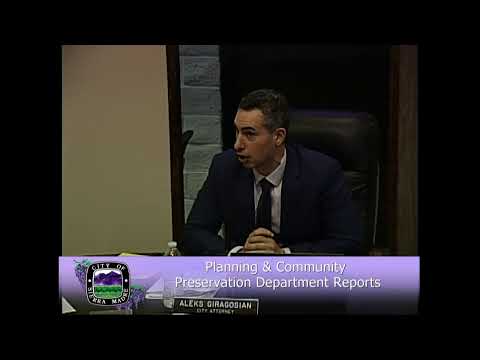
The Sierra Madre City planning commission heard a state legislative update Feb. 20 from the city attorney, who said the 2025 legislative session focused largely on fees and reporting requirements for housing development and made a handful of technical changes to density-bonus rules.
The Sierra Madre City planning commission heard a state legislative update Feb. 20 from the city attorney, who said the 2025 legislative session focused largely on fees and reporting requirements for housing development and made a handful of technical changes to density-bonus rules.
"This year, they really focused on fees," the city attorney said, summarizing a package of bills that require cities and utilities to post fee schedules and to provide preliminary fee estimates to applicants. He said the changes generally increase transparency about water and sewer connection charges and other exactions developers face.
The update matters, the attorney said, because it gives property owners earlier cost certainty and in some cases pushes payment of certain development-impact fees to a later stage in the permit process. "Under the new set of rules . . . development impact[ ] fees are paid upon the issuance of the first certificate of occupancy unless the city doesn't issue a certificate of occupancy," he said.
The city attorney walked commissioners through several topics the state package addresses: (1) a requirement that cities and water and sewer utilities post estimated connection fees and timeframes online; (2) new rules allowing applicants to request a preliminary estimate of all fees and exactions with a required city response within 30 days; (3) changes that push some development-impact fees to the certificate-of-occupancy stage; (4) new public reporting obligations for inclusionary-housing in-lieu fees; (5) reductions to vehicular-traffic mitigation fees for projects next to major transit stops; and (6) limits on when cities can charge recurring monitoring fees for state-regulated affordable housing projects.
Commissioners and staff repeatedly noted that many of the new requirements already match current Sierra Madre practice. The city attorney said Sierra Madre already posts utility rate and connection-fee information online and typically collects the kinds of charges described at final inspection or at certificate of occupancy. Staff confirmed the city’s fee schedule reflects those practices.
The attorney also said inclusionary in-lieu fee reporting now must be done annually and every five years for amounts collected and projects funded; he noted Sierra Madre does not have an inclusionary housing ordinance. On density bonuses, he said the changes largely refine definitions and eligibility and do not produce major local changes for the city.
"A lot of movement in the fees space, but none that really impacts Sierra Madre because we already comply with everything or it doesn't apply to us," the city attorney said, concluding his presentation.
Commissioners asked clarifying questions about how and when the city issues certificates of occupancy and whether local projects would be affected. Staff responded that the city issues a certificate of occupancy after final inspection when requested by a bank or escrow company, and that final sign-off on a building permit serves as a certificate of occupancy if one is not separately requested.
The presentation did not include any commission action; it was an informational staff report and discussion and concluded with the city attorney inviting follow-up questions.