Get Full Government Meeting Transcripts, Videos, & Alerts Forever!
Get email alerts on the Information Technology topic
No spam. Unsubscribe anytime.
Franklin IT seeks staff and tech upgrades, asks $1.2M for traffic, data-center and development tools
Summary
The City of Franklin information technology department asked the Budget & Finance Committee for three program enhancements totaling $1.2 million, a mid-level developer position, and funds to replace an aging data-center backup and HVAC system. Officials also outlined planned police records upgrades and an internal AI policy.
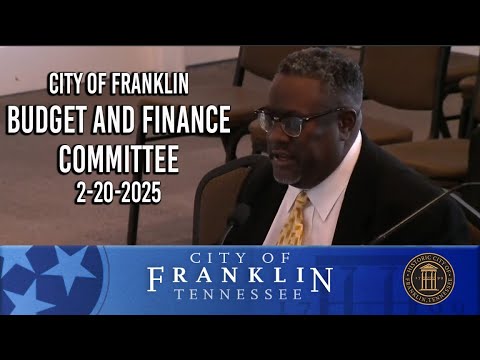
Jason Potts, director of information technology for the City of Franklin, told the Budget & Finance Committee on Feb. 6 that IT is seeking three program enhancements totaling $1,200,000 alongside one mid-level developer position to support in-house projects.
The request brings three enhancement items: (1) an additional IS Developer I to help the existing development team deliver integrations and applications across departments; (2) replacement of the battery backup (UPS) and data-center HVAC units at the police department, which Potts said are about 12 years old and have reached end-of-life; and (3) an “Edge Intelligence” expansion to bring traffic-signal data from all intersections back to the city and extend signal preemption and smart-corridor capabilities that already operate on a corridor along State Route 96. Potts said the three requests together total $1.2 million.
Why it matters: the UPS/HVAC system supports servers, firewalls and network equipment used for city operations; Potts said the unit has required temporary maintenance extensions from the manufacturer. The Edge Intelligence system is tied to public-safety objectives: automated preemption helps fire apparatus reach scenes faster by temporarily changing traffic lights after 911 dispatch, and the same data can be used for pedestrian safety and congestion management.
Potts described current IT accomplishments including rollout of Windows Hello for Business, automated server patch management, redundant internet circuits, GIS and downtown parking site updates, a park-finder tool, and an in-house application to automate “step-up” pay for fire personnel. He said the department closed more than 7,500 tickets in 2024 and over 27,000 tickets cumulatively in recent years.
On staffing, Potts asked again for an IS Developer I position, a mid-level role that would relieve the single existing developer and help expand integrations, data visualizations and departmental applications. He said the request had been made previously and described current in-house development as overwhelmed by smaller projects that nonetheless consume substantial time.
Regarding the police data center, IT staff said the existing UPS and HVAC units have reached the end of their serviceable lives. Mike Proctor, assistant director for infrastructure, said the system “powers and cools all of our electronic servers, storage, firewalls, routers and switches” and that continued operation on the existing equipment risks failures for which parts may not be available.
On Edge Intelligence and traffic preemption, Potts and assistant directors said the city already has fiber to most intersections and a working smart corridor on Highway 96. The preemption uses software (referred to during the meeting as “Neutron” in the vendor ecosystem) and integrates with fire dispatch so the system can automatically notify signals when an apparatus is en route. Cisco Solutions personnel have worked with the city; speakers said Cisco invited the city to present the work at an industry conference because the Franklin implementation is unusual in its integration and scale.
Potts also listed several near-term projects if funded: a records-management upgrade for the police department to consolidate systems and provide on-site training; technology planning for the new city hall build; and an internal artificial-intelligence policy the city is drafting before broader deployment.
Committee members asked for additional metrics (average ticket time, project vs. ticket breakdown) and whether maintenance contracts are multi-year; Potts said many large contracts (including Microsoft) run three-year terms and that multi-year contracts are used for cost savings where appropriate. The committee did not take a formal vote on IT capital or personnel requests; the presentation was informational and for budget planning.
Ending: Potts said IT will return with more detail on project timelines and contract terms, and staff emphasized that Edge Intelligence and the preemption work are being coordinated with the fire and engineering departments.