Get Full Government Meeting Transcripts, Videos, & Alerts Forever!
Get email alerts on the Consumer Protection Cfpb topic
No spam. Unsubscribe anytime.
Minnesota committee hears testimony on CFPB shutdown risk and state readiness to absorb consumer complaints
Summary
The Commerce and Consumer Protection Committee held an informational hearing Feb. 20 to examine recent disruptions at the federal Consumer Financial Protection Bureau and what those changes could mean for Minnesota consumers.
The Commerce and Consumer Protection Committee held an informational hearing Feb. 20 to examine recent disruptions at the federal Consumer Financial Protection Bureau and what those changes could mean for Minnesota consumers.
Committee Chair Cline opened the hearing saying the panel wants to “be vigilant to changes at the state and federal level that will impact our work in terms of consumer protection” and to assess potential state responses if the CFPB’s functions are paused.
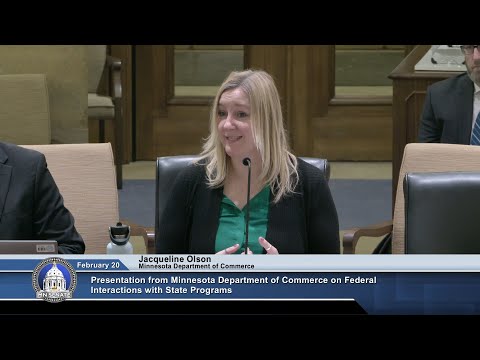
The hearing brought testimony from Jacqueline Olson, Assistant Commissioner and lead of the enforcement division at the Minnesota Department of Commerce, two public commenters who said the CFPB had directly helped them, and Attorney General Keith Ellison.
Olson told the committee that the Department of Commerce already shares jurisdiction with the CFPB on many consumer issues and will continue its enforcement work. “We do have concurrent jurisdiction with the CFPB on a lot of things,” she said. She summarized Commerce enforcement activity in 2024: the multi-industry team opened about 1,000 investigations, took 36 actions and assessed roughly $2.1 million in civil penalties with $450,000 returned to consumers; the real estate, mortgage and title team opened about 673 investigations and took 53 actions with $630,000 in penalties; and the senior fraud team opened over 1,000 investigations and placed holds on about $7.7 million to prevent exploitation of seniors and vulnerable adults. Olson said those teams will continue their work.
Olson also stressed limits to state authority. She told the committee Commerce does not have jurisdiction over federal banks, federal credit unions or the national credit reporting agencies; those are primarily within CFPB authority. When Commerce receives complaints outside its jurisdiction it typically refers them to the CFPB and, if appropriate, to the Office of the Comptroller of the Currency or the Federal Deposit Insurance Corporation.
Two Minnesotans offered personal accounts of consumer harms the CFPB helped address. Australia Ford, a Metropolitan State University student and parent, described borrowing from a lender she later identified as predatory and said she was charged interest rates she estimated at 390 percent and substantial fees. “At one point, I paid $690 in interest and over a thousand dollars in late fees and charges all for a $280 loan,” Ford said, adding the CFPB and nonprofit groups helped her recover and stabilize her finances.
University of Minnesota student Jacob Richter described rent-setting practices and debt collection that he and others face. Richter said landlords and large property managers use algorithms and variable pricing that can raise rent unpredictably, and he warned that without CFPB oversight “renters will have nowhere to turn when landlords engage in price gouging, unfair fees and exploitative practices.” He also cited federal student-loan servicing problems, naming the servicer MOHELA and referencing Department of Education findings about billing and processing errors.
Attorney General Keith Ellison said the CFPB’s supervisory and enforcement powers for large banks are unique and cannot be fully replaced by state action. “There are certain things that the CFPB does that I cannot do,” Ellison said, citing CFPB supervisory authority that has uncovered large-scale abuses in the past. He warned that a pause in CFPB oversight would leave gaps: the bureau’s complaint system handles a large volume of consumer reports weekly and its civil penalty fund compensates victims in cases where defendants pay penalties. Ellison said his office stands ready to take on more consumer work but noted resource and statutory limits.
Committee members pressed Commerce about operational capacity and changes they had observed since reported federal actions on Feb. 7. Olson said Commerce has not seen a structural change to its referrals but has noticed an increase in consumer complaints, which may reflect the department’s outreach to the public. She said Commerce will monitor complaint volumes and types and will notify the committee of relevant data and resources, including a CFPB report of recommended state actions that Commerce has posted on the committee agenda.
Lawmakers asked for additional details about Commerce staffing and operations. Olson said the senior fraud team has three people, the multi-industry investigative team about seven, and the real estate/mortgage team about eight; she said those investigators are civil investigators (not licensed peace officers) and that the investigators are funded from the state general fund. Committee members requested follow-up materials Olson offered to provide, such as the CFPB report and figures on staff telework and complaint follow-up rates.
No formal votes or policy changes were made at the hearing. The committee recessed to await the Attorney General and concluded after his testimony.
The hearing highlighted two central points for Minnesota policymakers: state agencies can increase investigations and consumer intake, but they lack the CFPB’s federal supervisory powers over large banks and certain national entities; and Minnesota officials expect a likely rise in complaints and multi-state coordination among attorneys general and regulators if CFPB activity remains curtailed.
The Department of Commerce said it will send the CFPB recommendations report to committee members and continue to monitor and report complaint trends. Attorney General Ellison said his office will handle more consumer contacts if needed but that state enforcement is not a direct substitute for federal bank supervision.