Get Full Government Meeting Transcripts, Videos, & Alerts Forever!
Get email alerts on the Federal Budget Entitlements topic
No spam. Unsubscribe anytime.
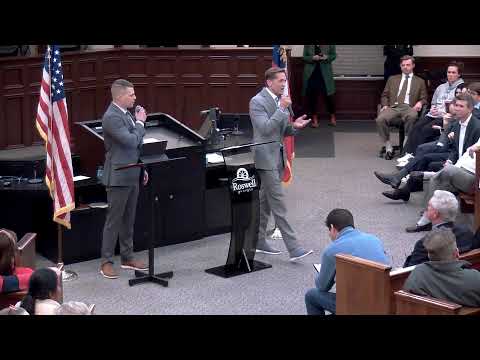
McCormick warns of fiscal cliff, urges bipartisan fixes to Social Security and mandatory spending
Summary
Rep. Rich McCormick told Roswell residents that mandatory spending on Social Security, Medicare and Medicaid dominates the federal budget and warned of automatic cuts unless bipartisan reforms are enacted.
Rep. Rich McCormick told a Roswell audience the federal budget faces a structural problem driven by mandatory spending on Social Security, Medicare and Medicaid and urged bipartisan adjustments to avoid automatic cuts.
In a series of exchanges about federal deficits and proposed program cuts, McCormick said, "75% of your budget is mandatory spending," and warned of an "automatic 21% cut" in about seven years if changes are not enacted. He described a range of bipartisan options he had discussed with colleagues, including gradual adjustments to eligibility timing and lifting the cap on payroll taxation for high incomes.
Why it matters: Constituents asked how proposed cuts would affect health care, school programs and pensions. McCormick said the size of mandatory spending makes deficit reduction complex and argued that small, bipartisan reforms spread over time could avoid sudden shocks to beneficiaries.
McCormick said Social Security and Medicare required attention because the programs’ financing trajectories were unsustainable at current spending and debt levels. "If you don't do something in about 7 years, we'll have an automatic 21% cut," he said, adding that the U.S. also faces rising interest costs that would reduce funds for other priorities.
He framed efficiency gains from technology — including use of artificial intelligence to reduce administrative costs — as part of a broader approach to curb health‑care inflation and improve program delivery. "AI can eliminate a large portion of that and make us much better at what we do," McCormick said, arguing administrative savings could free funds for needed services.
Ending: McCormick described debt and entitlement reform as bipartisan priorities and encouraged constituents to engage with lawmakers on trade‑offs, saying he was pursuing legislative fixes that could attract cross‑party support.