Get Full Government Meeting Transcripts, Videos, & Alerts Forever!
Get email alerts on the Medical Cannabis Zoning topic
No spam. Unsubscribe anytime.
Fillmore planning panel backs ordinance to allow delivery-only medical cannabis businesses in Business Park zone
Summary
The Fillmore Planning Commission recommended that the City Council adopt zoning and municipal code changes to allow non-storefront medical cannabis retailers and delivery operations in the Business Park zone, following a staff presentation about state law changes and a public hearing.
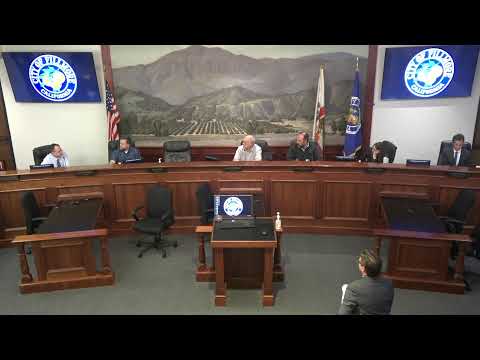
The Fillmore Planning Commission on March 5, 2025 opened a public hearing and voted to recommend that the City Council adopt a zoning ordinance amendment and related municipal code changes to allow non-storefront medical cannabis retail and delivery operations in the city’s Business Park (BP) zone.
City planner Brian McCarthy told the commission the change is necessary because Senate Bill 1186 made it unlawful for cities to outright ban medical cannabis sales or deliveries, and the proposed ordinance confines new medical-cannabis delivery and non-storefront retail to Fillmore’s BP zone while prohibiting on-site customer sales. “Senate Bill 1186…made it so cities cannot prohibit sales of medical marijuana or deliveries of medical marijuana,” McCarthy said, and staff drafted code text to allow delivery-only operations in enclosed, secure buildings and to require an operations plan and conditional-use permit for each applicant.
The planning staff framed the proposal as a narrowly tailored response to state law: the draft code adds definitions, design and operational standards, a conditional-use permit requirement, and a 600-foot separation standard from public parks, religious institutions, day-care facilities, schools and other hemp/cannabis facilities. Staff also proposed a video-surveillance requirement. McCarthy said the city previously adopted urgency ordinances to delay SB 1186’s effect locally while a permanent local ordinance was developed; the current stay the council extended runs through Dec. 11, 2025, he told the commission.
The commission’s discussion focused on compatibility, evidence of secondary impacts, and the scale of the Business Park. Commissioners asked whether any empirical data shows increased crime or other negative secondary effects around delivery-only, non-storefront medical facilities. McCarthy said he had sought input from the sheriff’s office and reviewed operations in nearby jurisdictions and that he found “no data to suggest that crime is higher surrounding these types of facilities,” but he explained land-use choices are typically driven by compatibility concerns such as traffic, parking and hours of operation. He added the Business Park was chosen because it already hosts industrial and storage-type operations and offers access and separation from schools and daytime child-care activity.
Two residents spoke during public comment. Annette Sula, a Fillmore resident of more than 40 years, opposed the change, saying the city is small and neighboring towns can serve patients: “I do not think that this is in the best interest of our community,” she said. Diane Sutton said she understood the limits on local authority but asked why medical cannabis is not handled through pharmacies and asked for more detail about the item’s legal and policy backing.
After public comment, a motion to adopt staff’s recommendation passed on a roll-call vote. The record shows the motion carried and the commission forwarded Resolution No. 205-1052 recommending the City Council adopt Zoning Ordinance Amendment No. 24-01 and Ordinance No. 205-976 to amend the municipal code to allow non-storefront medical cannabis retailers in the BP zone and delivery as required by state law; the record lists the action as approved by the commission. Staff noted any future CUP or building permit for a facility would be subject to the city’s operational and CEQA review and to the conditions spelled out in the adopted code.
The City Council will receive the planning commission’s recommendation and consider the ordinance and municipal-code amendments at a later public meeting; staff reminded the commission that applicants will still need a conditional-use permit and operational plan and that new construction or a project inconsistent with the Business Park Master Plan could trigger additional CEQA review.
Votes at a glance: the planning commission recorded a majority vote in favor of recommending council adoption; staff recorded the action as approved and forwarded to city council for final decision.
Why this matters: the change implements a state requirement while allowing Fillmore to limit retail activity to a zone staff judged compatible with deliveries and warehousing operations. The ordinance is written to require security and operational plans and to keep on-site sales prohibited, so any commercial operation would be deliveries only and subject to CUP conditions.
Next steps: the item will be placed on the City Council agenda for final consideration. Any operator seeking to open in Fillmore would subsequently apply for a CUP and demonstrate compliance with the new municipal-code requirements and with any CEQA obligations if a new building or other discretionary change triggers review.