Get Full Government Meeting Transcripts, Videos, & Alerts Forever!
Get email alerts on the Healthcare Building Safety topic
No spam. Unsubscribe anytime.
HCAI outlines integrated plan-review process, fees and roles in hourlong webinar
Summary
Department of Health Care Access and Information staff and an industry owner walked through the agency's optional integrated review process for large hospital projects, describing fees, phase/segment rules, contributor access to e‑plan review, and common pitfalls.
Presenters from the Department of Health Care Access and Information (HCAI) and a hospital owner explained the agency's integrated plan‑review process during a PIN 15 webinar that walked design teams through eligibility, schedule expectations and online tools.
Diana Navarro, supervisor of health facilities review at HCAI, said integrated review is “an optional plan review process that allows owners and design professionals to engage early on during the conceptualization phase of design, thereby eliminating the waste associated with developing a noncompliant design through to later design phases.” Navarro and Gary Downer, executive director of design and construction at Cedars‑Sinai Health System, spoke about when projects qualify, how increments and phase segments are defined, and how design teams should use HCAI’s e‑plan and reporting tools.
Navarro said the integrated review fee is higher than a standard incremental review: “The fee for integrated review and approval is 1.95% of the estimated construction costs as opposed to the 1.64% fee for incremental reviews.” She said integrated review typically applies to projects with estimated construction costs greater than $50,000,000 and that projects over $100,000,000 generally require building information modeling (BIM) and early involvement of general‑contractor and key subcontractors.
Why it matters: integrated review aims to reduce late redesign and unexpected construction delays by conditionally accepting discrete elements (phase segments) earlier in design. For large hospital projects, earlier clarity on code interpretations, fire and life‑safety items, accessibility and mechanical/electrical scope can change the schedule and cost trajectory of a project.
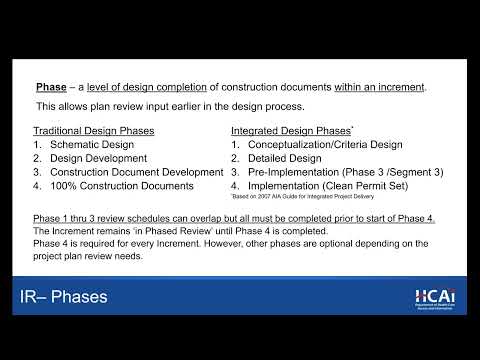
How the process works: HCAI staff described three core documents that launch an integrated review: (1) an application for an incremental project master, (2) a request for integrated review that outlines proposed increments and schedule, and (3) a project agreement that Navarro called “a legal document” committing the owner, the design team and HCAI to submission and review milestones. Navarro said every increment must include a final “phase 4” submittal that consolidates prior conditional acceptances into a set that can be stamped for permit.
Navarro and Downer reviewed the increment/phase/segment numbering convention and practical limits. Navarro said an increment can include multiple phase segments and that each increment is allowed up to 10 phase‑level submissions under the administrative code definition, but she recommended limiting the number of increments to four to six for manageability. She recounted a project allowed 16 increments that created major closeout and billing complications, and said teams should avoid breaking closely related work into separate segments.
Communication and meetings: presenters emphasized regular plan‑exchange meetings—pre‑ and post‑review sessions, and discipline‑specific meetings (for example, separate structural meetings)—to clarify unresolved comments. Downer described the plan‑exchange meeting as the place where teams upload plans to the e‑services portal and discuss how review comments will be resolved. Navarro said the meeting agenda is required so HCAI can assign appropriate reviewers and disciplines, and warned that disciplines listed but not on the agenda may not be available to attend.
Contributor access and reporting: Navarro described a contributor role license that HCAI assigns so key design‑team members can see reviewer comments and, when enabled by the reviewer, post responses inside the electronic plan‑review program. She noted that document upload and download remain tied to HCAI’s electronic services portal and that comment/response reporting is available from HCAI’s report center. Navarro advised teams to ensure user accounts are associated with the project record and to use filters to manage long comment lists.
Common pitfalls and lessons learned: presenters urged teams to resolve comments within the segment where they are made, limit owner‑driven late changes, and ensure the owner remains actively engaged. Navarro warned that unresolved issues carried into construction can cause critical code conflicts—for example, an omitted equipment relocation that made a service in a nonconforming building relied on by a conforming building. She recommended early, explicit discussion of design criteria and code questions on submittals rather than waiting for later back‑checks.
No formal actions or votes were taken in the webinar. Presenters encouraged interested architects and engineers to apply for HCAI staffing openings, noting resource constraints at the agency sometimes limit HCAI’s ability to accept integrated review agreements and may lead HCAI to recommend a standard incremental review instead.
Ending: Navarro and Downer closed by saying integrated review can speed complex projects when owners, design teams and HCAI commit to clear schedules, defined increments and active, timely communication. Navarro said HCAI will respond to written questions submitted during the webinar and will circulate answers to attendees.