Get Full Government Meeting Transcripts, Videos, & Alerts Forever!
Get email alerts on the Mileage Based User Fee topic
No spam. Unsubscribe anytime.
TAC approves high-level policy decisions to test automated and manual road‑charge reporting
Summary
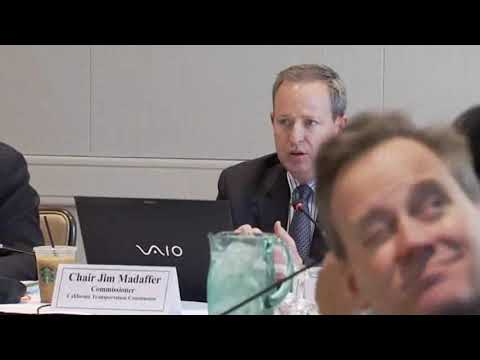
The Transportation Commission Technical Advisory Committee unanimously adopted high-level policy guidance to pilot both automated and manual mileage reporting, seek open-architecture options with data protections, and return detailed manual options at the next meeting; staff were assigned follow-up research items.
The Transportation Commission Technical Advisory Committee on an item labeled “policy decisions” unanimously approved high-level guidance to test both automated and manual methods for mileage-based road charging and to pursue an open architecture model with protections for participant data.
Carrie (staff member) introduced the item, saying, “Taking into consideration the previous presentations by Matthew on the operational concepts and enabling technology as well as the road charge pilot program architecture, there are some high level policy decisions that we'd like the TAC to take some action on today.” The committee then discussed technical maturity, participant burden, privacy and data‑use concerns, rural participation, and next steps.
The committee’s decision endorses offering automated distance recording and reporting in addition to manual reporting options for the pilot, directing staff to return detailed descriptions of the manual options at the next meeting and to avoid including options that would require development of wholly new hardware before a near‑term pilot. Committee members also asked staff to pursue an open system architecture while specifying safeguards on downstream commercial use of data.
Why it matters: The policy guidance frames how the pilot will be designed and evaluated. Several committee members emphasized that the pilot should be voluntary and should test options that could scale, while others raised privacy and vendor‑use concerns that could affect public acceptance and procurement. The committee also captured a short list of staff action items and “parking lot” research topics to inform future decisions.
Discussion highlights
- Technology maturity and evaluation: Several committee members said automated options (GPS and non‑GPS) exist in pilot contexts but questioned whether automated options were sufficiently mature to support reliable cost and scalability estimates. One committee member noted that pilot‑level costs typically understate long‑term operating costs and that more work was needed on business‑case modeling.
- Manual options: Committee members requested that staff return more complete detail on manual reporting options. In the meeting staff and members identified four manual variants to be developed further: a mileage permit, a time permit (flat fee for an assumed mileage class), an odometer prepay model and an odometer post‑pay model.
- Open system architecture and data use: Several members said they preferred an open architecture to avoid vendor lock‑in and encourage innovation, but at least one member warned that an “open” approach can enable private vendors to seek additional data or commercialize participant interactions unless the program includes explicit limits. A committee member noted that licensing or contractual oversight could limit downstream commercial use of program data.
- Rural participation and connectivity: Phil Dow, director of the Mendocino Council of Governments, urged the committee to include low‑tech alternatives for areas with limited broadband or cellular coverage so rural jurisdictions can participate. Phil Dow said, “I don't have very good broadband coverage in our area, and yet alone, cellular coverage in all areas. And so, I was hope that the committee would consider using all the alternatives available in the pilot study, including those who are very low tech for in consideration of the rural areas to make sure that we can, participate.”
Formal actions and follow-up
- Motion to adopt high-level policy guidance: The committee moved to adopt the high‑level policy decisions on the road‑charge pilot — including testing both automated and manual recording approaches, returning detailed manual options at the next meeting, pursuing an open architecture with safeguards, and excluding pilot options that require development of entirely new hardware. The motion carried unanimously; individual roll‑call votes are not recorded in the transcript.
- Motion to accept staff action items (parking lot): The committee also voted unanimously to accept a set of staff action items and parking‑lot research topics to return at future meetings. That motion was moved by Eric (committee member) and seconded by Marty (committee member); it carried unanimously.
Staff action items captured for the next meeting (as stated by staff): 1) Analyze how accelerating the pilot schedule would affect TAC work and staffing; 2) Engage Caltrans’ research channels (university transportation centers) to scope targeted research and white papers requested by members; 3) Invite or request a progress/final report from the Mineta/Minette Institute contact leading the NCHRP study on public attitudes and acceptance; and 4) Develop information on fraud, evasion, privacy and cybersecurity vulnerabilities tied to reporting methods (with an in‑depth compliance/enforcement discussion planned for a later meeting).
Next steps and timing
Staff agreed to return more detailed materials at the next meeting, including fleshed‑out manual options and tighter definitions of which automated approaches would be tested. The committee noted the next meeting date as April 24 in Monterey, California, and asked members to submit additional topics to staff in advance.
The committee’s decisions are procedural direction for the pilot design; no statewide policy or program implementation was adopted during the meeting.