Get Full Government Meeting Transcripts, Videos, & Alerts Forever!
Get email alerts on the Utility Regulation topic
No spam. Unsubscribe anytime.
Oregon PUC outlines rate‑setting process, cites wildfire mitigation and wholesale power costs as major drivers
Summary
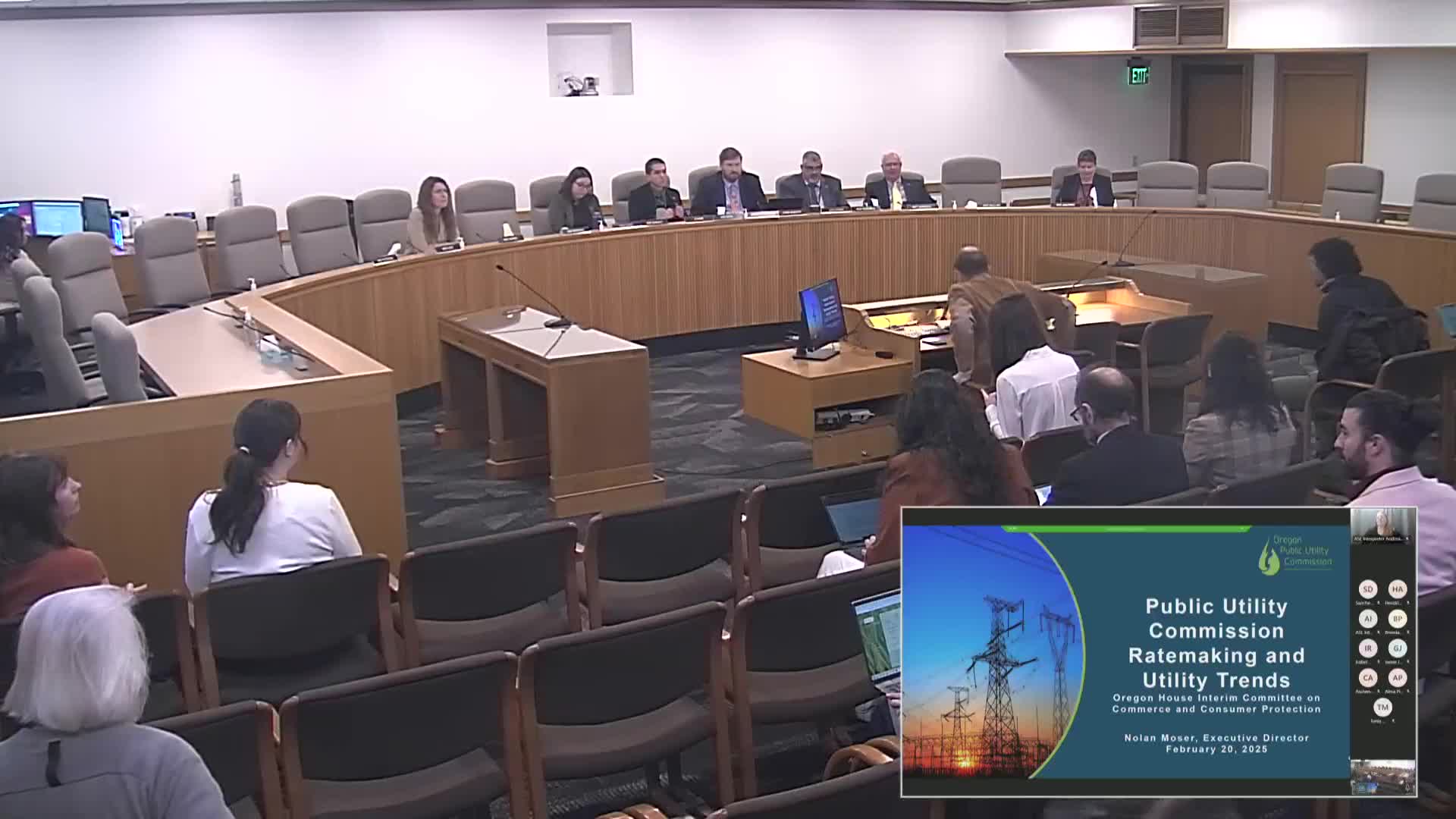
Nolan Moser, executive director of the Oregon Public Utility Commission, told the House Committee on Commerce and Consumer Protection on Feb. 20 that the commission’s contested rate cases and rising costs for wildfire mitigation, wholesale power and grid replacement are driving recent utility rate increases.
Nolan Moser, executive director of the Oregon Public Utility Commission, told the House Committee on Commerce and Consumer Protection on Feb. 20 that the commission’s rate‑setting work centers on balancing utilities’ need to recover prudent costs with consumer protections for affordability, safety and reliability.
Moser outlined the PUC’s authority and process for general rate cases, described recent organizational changes intended to better align planning and rates work with customer affordability, and identified wildfire mitigation, rising wholesale power prices and an aging grid as major reasons for recent utility rate increases.
The commission, Moser said, is the economic regulator for investor‑owned electric, natural gas, small telecom and some water utilities in Oregon. “Our commissioners act as judges in certain matters, and essentially as policy makers through rule makings,” he said, adding that the agency has three full‑time commissioners and cited staffing figures in the presentation. He described contested general rate cases as quasi‑judicial proceedings in which utilities file testimony and evidence, stakeholders and staff respond, and administrative law judges manage prehearing and evidentiary steps before the commission issues a written decision.
Moser said last year the PUC handled an unusually high number of contested general rate cases — four major cases — and that utilities rarely receive the full amount they request after staff and stakeholder scrutiny. He described the role of PUC staff — accountants, economists, engineers and others paired with Department of Justice attorneys — in issuing data requests, preparing testimony and developing settlement positions.
On the drivers of higher bills, Moser told the committee that competition for labor and equipment since the pandemic, higher wholesale power and natural gas prices, increased spending on wildfire mitigation and replacement of old transmission and distribution infrastructure have all contributed. “We have a utility system that, at least here in the West in parts, was built 70, 80 years ago. We need to make significant investments in grid infrastructure to maintain safety and improve reliability,” he said.
He described steps the PUC has taken to broaden public participation in rate proceedings, including multilingual public comment hearings, Spanish interpretation, media outreach, and in‑person hearings in service territories such as eastern Oregon when appropriate. The PUC also reorganized staff to place planning and rate work under a single strategic leader, Moser said, with the goal of making policy work more attentive to rate impacts.
Committee members asked about whether the PUC can initiate rate cases, how wildfire mitigation spending is evaluated, and which customers provide the most public comment. Moser said staff can instigate a rate review in some circumstances and that the PUC reviews utility wildfire mitigation plans for safety and efficiency; he also said the commission has received a relatively higher volume of comments from Portland General Electric customers.
The briefing closed after Moser took questions from representatives on the committee.
Ending: The committee then opened a public hearing on House Bill 3179. Members said they would continue discussion of rate‑setting policy during the HB 3179 hearing and scheduled further consideration of the bill at a later date.